Cold chain
Intelligent pre-cooling systems give fresh produce exporters tighter control over quality and shelf life
Sean Roche of Cold Change Group explains how variable-speed drives, PLC automation, and product-specific cooling programs are transforming pre-cooling from a fixed-cycle process into a precisely controlled operation. The shift affects energy costs, shelf life, and the ability to serve distant markets via sea freight.
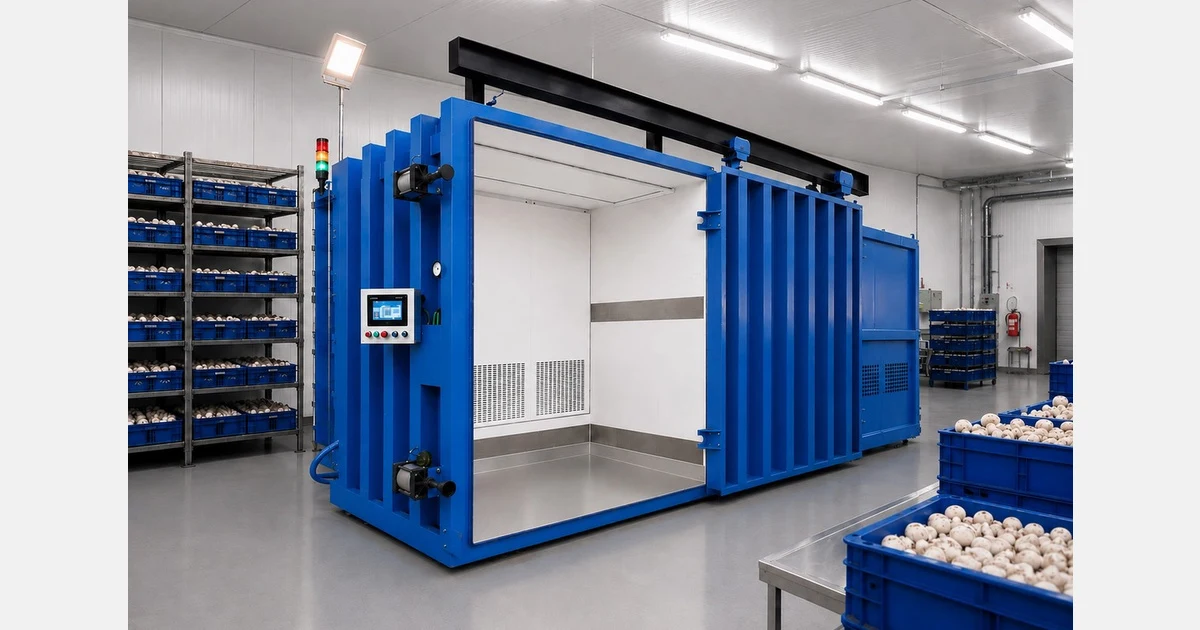
Pre-cooling for fresh produce is evolving from a fixed-cycle operation into a precisely controlled, product-specific process, according to Sean Roche, managing director of UK-based Cold Change Group. The shift, driven by variable-speed drives, PLC-based automation, and remote data logging, is changing how exporters manage quality, energy costs, and market reach.
Smarter control, product-specific cycles
Roche notes that the major development in pre-cooling is not a new cooling method but a step change in how intelligent and controllable the equipment has become. Vacuum cooling, hydro cooling, forced-air cooling, and blast chilling have all existed for many years; what is changing is the technology around them. At Cold Change Group, the company has developed its systems using variable-speed drives, improved refrigeration controls, PLC-based automation, product-specific cooling programs, and remote data logging to give the operator much better control over the process.
Different crops require different cooling conditions, which is making product-specific programmes increasingly important. With vacuum cooling in particular, the cooling cycle can now be optimized very precisely. As growers expand into different crops, they often have two or three different types of product to cool — for example, broccoli, cauliflower, and cabbage. Different products behave differently under vacuum, and for ultimate optimization there will be different settings for the cooling process.
The settings depend on the product itself, its weight, moisture content, and density. This could mean the refrigeration system needs to engage earlier or later in the cycle to complete a perfect cooling cycle. If this is not done correctly, the product could lose too much moisture during the cycle, which could ultimately affect quality.
Automation is helping make this level of control easier to apply in daily operations. Rather than simply switching a machine on and running every crop through the same cycle, programs are developed for individual products, temperatures, and load conditions. The operator selects the product to cool during a particular cycle, and the machine automatically controls the process via a touch screen tailored to each customer's operation. Operators should not need to understand the refrigeration engineering behind the machine; ideally, they select the product or programme and the control system manages the cooling process. Remote monitoring and diagnostics also allow manufacturers and engineers to support equipment thousands of miles away, which is particularly valuable for exporters operating in remote growing regions.
Energy use and choosing the right method
Alongside cooling performance, energy consumption has become an important consideration in the development of pre-cooling systems. Roche states that there is little benefit in saving fresh produce from post-harvest losses if the cooling process itself is unnecessarily energy intensive. The company has done many years of research and development investigating the complete system, including vacuum pumps, refrigeration, water use, heat recovery, controls, and cycle times.
Selecting the right cooling method can have a considerable impact on both operating costs and product quality. According to Roche, there is no single system suited to every crop. Leafy vegetables may be extremely well suited to vacuum cooling, while other crops — for example, cherries, grapes, apples, and carrots — may benefit more from hydro cooling, forced-air cooling, or blast chilling.
He recalls an example in which changing the cooling method substantially reduced cooling times for a leafy product. A customer had been using blast chilling or forced-air cooling to cool leafy greens in packaging for years; the cycles took up to 10 hours and were extremely energy intensive. Changing to a vacuum cooler took cooling times down to 17 minutes, from 20 °C to 4 °C. The savings on energy bills alone paid for the vacuum cooler within a very short period. The quicker cooling time increased shelf life by four days, and the quality was dramatically improved.
The example illustrates why the choice of technology should be based on the product and operation rather than simply on the equipment available from a particular supplier. Roche notes that Cold Change Group is the only company in the world that sells four different types of pre-coolers, covering almost every type of fresh produce, and that the company will advise a customer on the correct pre-cooler for their product specifically. A major mistake some people make, he says, is choosing a supplier first and then approaching, for example, a blast chiller company that will try to sell its chiller regardless of whether it is correct for the operation.
© Cold Change Group
Pre-cooling as the cold chain's first stage
For exporters, the speed at which field heat is removed remains central to preserving the condition of the product after harvest. Fresh produce begins deteriorating from the moment it is harvested; the key is that the faster the field heat is removed, the longer the shelf life and the better the quality.
Pre-cooling also needs to be considered separately from simply placing produce in refrigerated storage. A conventional cold room may eventually cool the product, but that does not necessarily mean it has been cooled effectively. The longer field heat remains in the product, the more valuable shelf life can potentially be lost before the produce even starts its journey.
Roche believes cooling requirements should be considered before a packhouse is built or expanded. Pre-cooling needs to be considered at the design stage: the operator must understand what is being harvested, the quantity arriving per hour, its incoming temperature, the required final temperature, and how quickly it needs to reach that temperature. Only then can the correct technology and capacity be determined.
The role of pre-cooling extends beyond the packhouse itself, particularly once produce enters longer and more complex supply chains. In Roche's opinion, this is where the real value of pre-cooling is sometimes underestimated. The cold chain does not begin when a refrigerated truck arrives at the packhouse or when a container is loaded onto a ship; it should begin as close to harvest as practically possible.
If produce enters the cold chain carrying significant field heat, every stage afterwards is effectively trying to recover from a poor start. Refrigerated storage, trucks, and shipping containers are generally much better at maintaining an established product temperature than trying to remove large amounts of field heat from fresh produce. Effective pre-cooling changes that: if the product is rapidly brought to its optimum temperature before storage and transportation, the rest of the cold chain is starting with produce already down to temperature, and its only job is maintaining that temperature.
© Cold Change Group
Longer shelf life, wider markets
Additional shelf life can also create opportunities to serve more distant markets and reconsider transport options. With a proper pre-cooling setup, the user can utilize the additional shelf life and reach markets further away from the place of origin, ultimately allowing them to expand their business. There can also be an important economic argument: air freight is extremely fast but expensive, while sea freight is generally considerably slower but can be much more economical. If better post-harvest cooling and cold-chain management gives an exporter enough confidence in the condition and remaining shelf life of their produce to use longer transport routes, the economics of exporting can change significantly.
© Cold Change Group
Roche sees pre-cooling as part of the wider effort to protect the value of produce throughout its journey. Pre-cooling should not simply be viewed as another piece of refrigeration equipment or another cost in the packhouse; it is the first stage of protecting the value of everything the grower has spent months producing. And when exporting fresh produce locally or thousands of miles, getting that first stage right can influence everything that follows.
For more information:
Sean Roche Cold Change Group Tel: +44 7912691713 (whatsapp) Tel: +447768795866 [email protected] www.coldchange.com
ORIGINAL SOURCE
FreshPlaza: Cooling ↗Visit the original source for additional details.