Industrial refrigeration
Right-Sizing Heat Rejection: Why Oversized Cold Storage Cooling Costs More Than It Saves
Oversizing heat rejection systems in cold storage warehouses drives up water and energy consumption while creating contamination and maintenance risks. The article compares evaporative condensers and cooling towers with heat exchangers, outlining project-specific factors that should guide the selection rather than a default to maximum capacity.
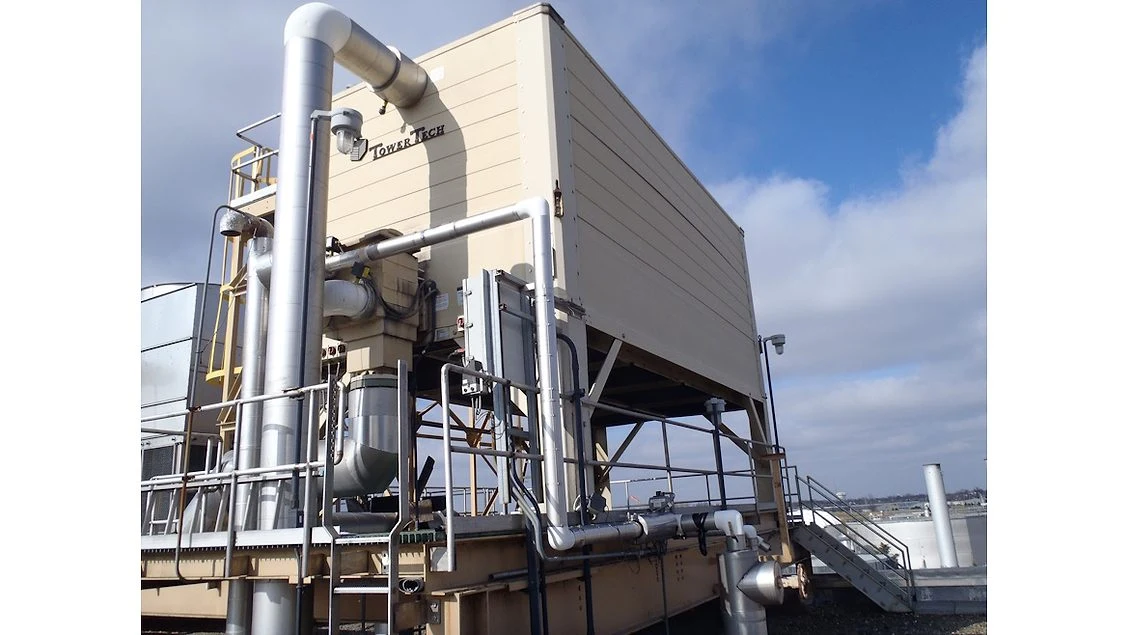
Cold storage operators have long defaulted to oversized heat rejection systems as insurance against chiller downtime, but that approach is quietly inflating water bills, energy costs, and contamination risk. A right-sized solution matched to the actual heat load and operating profile can cut those costs without sacrificing reliability.
Why the default persists
Because a cold storage warehouse cannot tolerate chiller downtime — constant temperatures protect the bottom line and reduce waste — many facilities design in substantial extra capacity. The logic is straightforward: if an outage is unacceptable, build in a large margin. That reasoning has made outsized cooling systems the industry norm, and useful reserve capacity is not inherently wrong. The problem emerges when the heat rejection system is oversized to the point of consuming excessive water, losing efficiency, and creating temperature-maintenance issues that open the door to contamination. Defaulting to traditional sizing assumptions rather than fitting a cooling solution to a specific use case may well be costing businesses in meaningful ways.
Where evaporative condensers still make sense
Evaporative condensers remain the natural choice for large, single-purpose projects that benefit from a single integrated piece of equipment. They eliminate the need for a separate heat exchanger, keep cooling to a single step, and can handle high pressures with refrigerants such as ammonia. They are well suited to cold storage warehouses that need very low temperatures, such as large ice-making distribution operations.
The trade-off is energy and water. Older evaporative condenser models are prone to fouling, sedimentation, and scale buildup, which reduce cooling efficiency and lower cycles of concentration. The result is more frequent water purging and make-up to keep water chemistry within specifications.
Where cooling towers with heat exchangers fit
For smaller or mid-size systems, a cooling tower paired with a heat exchanger can meet the cooling requirement while cutting energy costs. Modular or factory-preassembled towers are well suited to brownfield retrofits and small footprints. As an example, a high-heat-transfer application such as an industrial ice cream freezer can keep product frozen at a fraction of the energy use of a conventional condenser system when paired with a high-efficiency heat exchanger.
Cooling towers also offer advantages at high-scale-potential cold storage sites. An "N+1" capacity design builds in redundancy, and modular multi-fan towers equipped with a variable-frequency drive (VFD) can modulate output to match the facility's actual load at any time of year — a particular benefit for operations that do not always run at peak. A modular design also allows portions of the system to be turned on or off to meet seasonal conditions.
High-efficiency cooling towers deliver higher cycles of concentration and ultra-low drift, minimizing water loss, especially in an N+1 configuration. A closed-circuit model further eliminates splash-out and other sources of water loss. Because the heat exchanger isolates the clean secondary loop that contacts the chiller, contamination, scaling, sediment, and fouling are shifted onto a less expensive, easier-to-replace component rather than onto pressure-rated refrigerant coils. This protects critical equipment in cold storage facilities, frozen food processing plants, and data centers.
Factors to weigh when selecting a cooling method
Heat load and cooling capacity remain the primary considerations, but for too long they have been the only ones, costing businesses resources through over-cooling. Other factors to evaluate include:
- Pressure requirements. Evaporative condensers handle refrigerant directly, making them the superior choice for high-pressure refrigerants.
- Energy use. Evaporative condensers can be more energy-efficient by keeping cooling in a single step, but a high-efficiency cooling tower can reduce energy use by increasing cycles of concentration.
- Water use. High-efficiency cooling towers offer higher cycles of concentration and ultra-low drift; a closed-circuit model removes splash-out.
- Contamination reduction. A cooling tower with a heat exchanger isolates the secondary loop, shifting fouling and scaling to a replaceable component.
- Ongoing maintenance and operation. Factor in estimated costs for replacement parts, preventive maintenance, and emergency repairs; purchase price is only one part of the total cost of ownership.
- Ease of maintenance and personnel safety. Components that are easier to access during inspection and maintenance speed up work and keep workers safer, which matters in facilities with limited maintenance staff.
- Growth capacity. Swapping one solution for another is difficult, and expanding an evaporative condenser system once installed requires structural work and downtime. A modular cooling tower is much easier to expand by "daisy-chaining" additional cells, and an N+1 design allows production to continue while a tower is serviced or added.
Let project needs lead
The industry proverb "nobody ever got fired for buying IBM" captures the built-in insurance of choosing a large, trusted solution. For cold storage, that has meant defaulting to evaporative condensers. But when managing resources and ongoing costs are top of mind, a cooling tower may match the heat load within a broader use context. Letting the project's specific needs drive the decision, rather than defaulting to a largest-size-fits-all approach, can yield a sustainable, long-term-benefit cooling solution.
Mohammad Haider, who writes the article, works in capital project management and process optimization at Tower Tech, a manufacturer of modular cooling towers. He is a licensed professional engineer with multi-disciplinary expertise spanning chemical engineering, polymer materials, mathematics, and computer science, and more than eight years of plant operational experience, particularly in high-volume manufacturing of chilled water systems and composite materials.
Source: FROSTlines, November 13, 2026.
ORIGINAL SOURCE
ACHR NEWS ↗Visit the original source for additional details.