Industrial refrigeration
Technical Criteria, Not Age, Determine When to Replace a Refrigeration System
The decision to repair, upgrade, or replace refrigeration or HVAC equipment should be based on a comprehensive technical-financial assessment rather than the age of installation. ABRAVA consultant João Roberto Gonçalves highlights key parameters: condition and maintenance history, refrigerant, energy efficiency, payback period, and application criticality.
When deciding the fate of a refrigeration or HVAC system, the age of the equipment serves only as a starting point. According to João Roberto Gonçalves, a technical consultant in refrigeration and HVAC engineering and a course instructor at ABRAVA, the determining factors are the combined set of technical and financial indicators.
In commercial and industrial applications, keeping older equipment in operation may seem like the less costly option. However, the accumulation of repeated repairs, declining efficiency, and the risk of breakdowns change this picture over time. At the same time, prematurely replacing a functioning unit is not always the optimal use of resources. Gonçalves recommends conducting a technical-financial analysis of the entire system.
Condition and Maintenance History
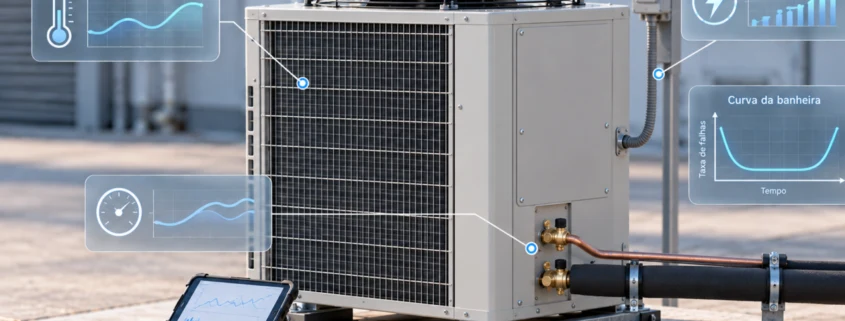
The first step is assessing the current condition and operational history. The «bathtub curve» methodology allows tracking the behavior of failure frequency throughout the lifecycle: from the early-failure period through the stable phase to the wear stage, when the frequency of breakdowns increases. According to Gonçalves, the bathtub curve itself does not determine the moment of replacement, but when a system enters the wear phase, the information obtained is compared with maintenance costs, performance, energy consumption, and the criticality of the installation to assess the feasibility of upgrading or replacing it.
Analysis of the maintenance history reveals whether interventions are isolated or becoming increasingly frequent. Repeated failures in different components signal a trend toward rising maintenance costs and declining reliability. At the same time, it is not enough to evaluate the cost of the next repair in isolation: accumulated expenses over the years and their ratio to performance must be considered. The decision is also influenced by the difficulty of sourcing spare parts and the time required to carry out the work.
Refrigerant and Retrofit
The refrigerant has become one of the significant factors in assessing service life. The evolution of environmental regulations and the need to reduce the impact of certain substances may require adaptation of existing systems. However, the technical feasibility of a retrofit does not automatically mean it is the most cost-effective alternative. Gonçalves points out that, given the Montreal Protocol, a refrigerant may be replaced, but if other repairs or modifications are simultaneously required, the combined cost of interventions may justify a full equipment replacement. A retrofit should be considered within the framework of a broader project: changing the refrigerant may require modification of components, control systems, throttling devices, lubricating oil, or other elements of the circuit. The total cost of these works is compared with the investment in a new solution.
Energy Efficiency and Payback Period
Energy consumption is one of the key parameters when comparing older equipment with more modern technology. Systems that continue to operate after years of use and a series of interventions may demonstrate performance lower than that of new installations. A feasibility analysis should compare current performance with the calculated consumption of a new solution to determine whether the operational savings offset the investment and over what period.
Gonçalves emphasizes that the payback period calculation should not be limited to the difference in electricity consumption. The economic assessment includes maintenance costs, spare parts availability, labor costs, downtime for interventions, and potential losses due to failures. In some applications, a more efficient solution implies a larger initial investment but reduces operational costs over the lifecycle. Similarly, older equipment may have an already depreciated purchase cost but require growing expenses to keep it running.
Reliability and Application Criticality
Reliability takes on special significance in installations where a shutdown can put products, processes, or operational continuity at risk. In a cold storage room, a prolonged failure can lead to loss of stored product; in an industrial application, a shutdown affects the entire production line. The presence of backup or redundant equipment is also taken into account: an installation with redundancy allows longer operation of older units, while an application without redundancy requires a more conservative approach. The criticality of the stored product and the availability of backup can be a strong argument in favor of replacement or upgrade.
Total Cost and Planning
Ultimately, equipment replacement should not be determined by a single indicator. The main criteria include: condition, repair history and frequency, spare parts availability, refrigerant, energy consumption, performance, maintenance costs, need for modifications, reliability, and redundancy. A total cost of ownership analysis over the lifecycle allows assessing how much will be needed to maintain the current system and comparing this with the investment and projected operational costs of a new technology.
Gonçalves notes that planning is important: identifying signs of aging before a critical failure allows scheduling the replacement at an appropriate time, reducing the impact on operations, and considering various technological alternatives. For the refrigeration and HVAC industry, this approach contributes to more predictable investment planning, aligned with the specific needs of each application.
ORIGINAL SOURCE
Revista do Frio ↗Visit the original source for additional details.