Chillers & heat pumps
Industrial High-Temperature Heat Pumps: From Niche Technology to Boiler Replacement Amid the 15th Five-Year Plan
The 15th Five-Year Plan explicitly identifies large-scale industrial boiler replacement as a key market opportunity. Yu Taizeng, Senior R&D Director at Zhongguang Electric, describes how high-temperature heat pumps with two-to-four-stage compression cover heat demands up to 150 °C; the 2024 market reached 1.23 billion yuan, up 18% year-on-year.

The 15th Five-Year Plan explicitly identifies large-scale renewal and modernization of industrial boilers as a key market opportunity for coal and gas replacement. It is in this context that high-temperature heat pumps, recently considered a niche segment, are entering the industrial market. In an interview with Refrigeration Express and Refrigeration Business, Yu Taizeng, Senior R&D Director of Zhongguang Electric Group, discussed market prospects, technical solutions, and practical implementation experience.
Market: From 0.113% Penetration to Hundreds of Billions of Yuan
According to the "White Paper on the Development of Industrial Heat Pumps" published by the China Association for Energy Conservation, industrial heat supply accounts for 52% of final energy consumption, of which 74% is provided by fossil fuels. Association experts calculated the potential demand for heat below 200 °C: at a supply temperature of 100 °C, the volume is 649.9 million GJ; at 150 °C — 1.1095 billion GJ. Yu Taizeng notes that with full coverage of demand below 200 °C, the high-temperature heat pump market for equipment alone could reach a scale of hundreds of billions of yuan.
In 2024, the domestic market for high-temperature heat pumps reached 1.23 billion yuan, up 18% year-on-year. However, the application penetration rate does not exceed 0.113%, and the segment accounts for approximately 4% of the overall heat pump market.
Technology: Two-to-Four-Stage Compression and a Dedicated Compressor
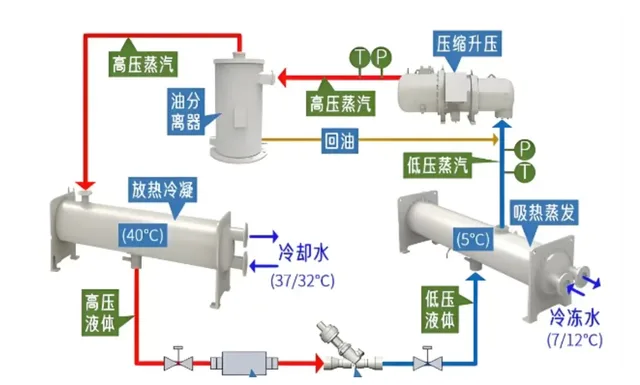
To achieve condensation temperatures of 100–150 °C with a temperature difference exceeding 50 K, configurations with 2–4 compression stages are employed. Interstage steam injection is organized to increase heating capacity and improve aerodynamics at higher stages. For even larger temperature differences, cascade or sequential cycles with separate high- and low-pressure compressors are used, each operating within its own compression ratio and discharge temperature range.
The key challenge at high compression ratios is compressor reliability. Yu Taizeng highlights two approaches: distributing the total pressure differential across 2–4 stages to reduce the load on each, and controlling discharge temperature by selecting the appropriate stage ratio and intermediate temperature.
Zhongguang Electric has chosen a dedicated screw compressor for high-temperature operation. Key features: capacity regulation via variable-frequency drive instead of a traditional sliding valve (which prevents refrigerant from entering the oil cylinder and improves part-load efficiency); a dedicated internal volumetric ratio and optimized discharge windows to reduce under-compression losses; an oil-cylinder-free design that reduces oil consumption by 90%; a narrow H-profile to minimize internal leakage; and dual bearings against reverse rotation.
Zhongguang Electric's product line covers three temperature ranges:
- Hot water 50–60 °C — food, beverage, and pharmaceutical industries;
- Hot water 50–90 °C — oil refining;
- Low-pressure steam 80–120 °C — coal industry.
All models in the series meet the first energy-efficiency class under H5b conditions, with a maximum COP of 4.96, which is 38% above the first-class threshold.
Practice: The Tushan Pharmaceutical Project
Yu Taizeng cites the example of a Tushan Pharmaceutical plant upgrade: the line processes more than 2 tonnes of raw material per hour with an annual operating time of 8,000 hours. Before the upgrade, heat was supplied by boiler steam; after — by a custom industrial heat pump system from Zhongguang Electric. According to calculations, the system saves at least 70% of energy costs compared to a boiler house and pays back within 2 years.
System commissioning took 3–10 days on site: system, software, and service engineers jointly verified heat source conditions, piping, cascaded temperature utilization, and power supply. For non-standard projects, Zhongguang Electric has formed a dedicated team of R&D, technology, quality, and service specialists, which reduces commissioning time and ensures support during the operating phase.
Barriers and the Path to Trust
Yu Taizeng emphasizes that every industrial facility has unique conditions regarding heat source and temperature requirements; some projects face instability or corrosive activity of the heat transfer medium. The solution is a tailored project accounting for specific conditions, including coupling with air-source heat pumps, cascaded temperature utilization, and the use of corrosion-resistant materials.
A separate challenge remains customer distrust: industrial production imposes strict stability requirements, and the track record of high-temperature heat pump applications is still limited. According to Yu Taizeng, the key to overcoming this barrier is reference projects with verified performance data, not just theoretical calculations.
The 3–5 Year Horizon
Yu Taizeng identifies four technology directions for the next 3–5 years: moving toward higher temperatures, greater heating capacity, improved energy efficiency, and increased intelligence; commercialization by temperature range — accelerated deployment in the 120–160 °C segment and transition of prototypes above 160 °C to serial production; development of low-GWP refrigerants; and new compressor designs, including magnetically levitated vapor compressors for ultra-high temperatures.
In his assessment, heat pumps can raise the temperature of medium- and low-temperature heat to 150 °C with a 60% utilization rate, making them a competitive alternative to boilers in the chemical, food, and metallurgical industries.
ORIGINAL SOURCE
制冷快报 ↗Visit the original source for additional details.