Industrial refrigeration
Daikin and NTT DATA to Test AI-Based Data Center Cooling Optimization in Joint PoC
Daikin and NTT DATA will run a joint proof of concept starting July 2026 to develop an AI model that predicts server thermal conditions from indirect data and coordinates control of HVAC, chiller, and liquid cooling systems. Validation testing will take place at an NTT DATA data center in Japan during FY 2026, with commercialization targeted for FY 2027.
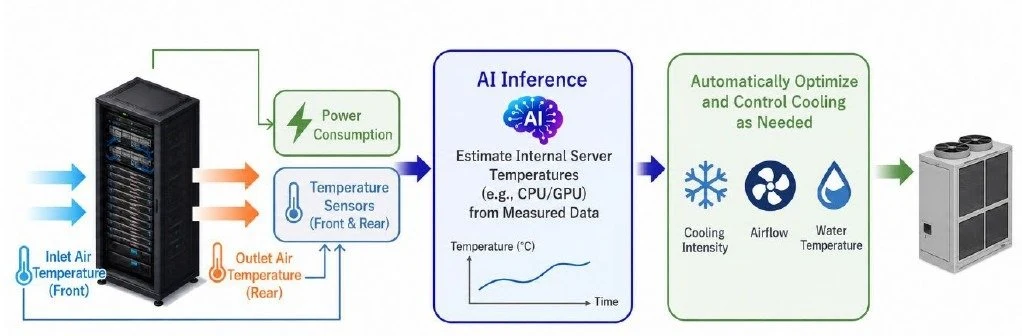
Daikin Industries and NTT DATA Japan will begin a joint proof of concept in July 2026 for a next-generation cooling optimization solution that uses AI to predict server thermal conditions and enable integrated management of HVAC, chiller, and liquid cooling systems in data centers.
Why current cooling strategies are straining
The rapid adoption of generative AI has accelerated the deployment of high-performance AI servers, which incorporate a larger number of GPUs and deliver significantly higher processing performance while consuming substantially more power and generating greater heat than conventional servers. Their workloads also fluctuate more sharply, making cooling efficiency a critical challenge for data center operators.
Traditional cooling strategies based on fixed operational rules or equipment-level optimization are becoming increasingly difficult to apply. In many data centers, security and operational constraints limit access to detailed internal server information such as processor temperatures and workload data. Cooling systems are therefore often controlled using temperature sensors installed near server racks, but ambient temperatures around servers do not always reflect actual thermal conditions inside the servers themselves. The result can be excessive cooling that drives up energy consumption and electricity costs, or insufficient cooling that threatens system reliability.
How the solution works
The PoC will jointly develop an AI model that predicts server thermal conditions using indirect indicators such as power consumption and temperature data, even in environments where detailed internal server data cannot be directly accessed. The model learns relationships between server workloads and thermal behavior to estimate conditions that more closely reflect the actual state of servers.
Based on these predictions, the solution enables coordinated control of HVAC, chiller, and liquid cooling systems rather than optimizing each system independently. The goal is to maximize cooling efficiency across the entire data center, reduce overcooling, and improve responsiveness to changing workloads.
The initiative also combines NTT DATA's expertise in operating data centers across diverse environments and its correlation data on the relationship between server behavior and cooling performance with Daikin's advanced control technologies for HVAC and chiller systems and its AI-based HVAC control capabilities.
Project scope and timeline
- Validation period: July 2026 through March 2027, at an NTT DATA data center in Japan.
- FY 2026 objectives: evaluate the accuracy of AI-based server thermal condition prediction and assess the effectiveness of integrated cooling system control in improving energy efficiency, reducing electricity costs, and enhancing operational automation.
- Commercialization target: FY 2027, with plans to expand the solution to data centers in Japan and other markets as a next-generation cooling solution designed for the AI era.
Division of responsibilities
NTT DATA will provide data center operational expertise and correlation data on server behavior and cooling performance, supply the Green DC energy management system (GDCEMS) for energy monitoring and analytics, co-develop and evaluate the AI model, and provide the validation environment.
Daikin will provide control technologies and operational expertise for cooling, chiller, and liquid cooling systems, supply AI-driven equipment for autonomous optimization of cooling operations, co-develop and evaluate the AI model, and operate the equipment to verify performance outcomes.
GDCEMS is an energy management platform provided by NTT DATA to support data center decarbonization. It offers real-time visibility into power consumption and greenhouse gas emissions and supports optimization through AI-enabled cooling control. By combining GDCEMS with the AI-based thermal prediction and integrated facility control developed under this initiative, NTT DATA aims to further enhance energy management across the entire data center.
The companies state that the solution is expected to help data center operators lower electricity costs and improve operational efficiency while supporting ESG initiatives and contributing to reduced greenhouse gas emissions.
ORIGINAL SOURCE
Daikin Global: Press ↗Visit the original source for additional details.