Industrial refrigeration
KKS Installs One of Europe's Largest Hisense VRF Systems for CO₂-Neutral Air Conditioning of Logistics Centers
The project combines 35 AHU units, 80 Hisense VRF outdoor units, and a 28-MW photovoltaic power plant. The key design solution is placing VRF outdoor units in the AHU exhaust air stream (around 20 °C), which reduces defrost cycles and increases COP. Total system capacity is 4,253 kW with an air flow of approximately 1,088,500 m³/h.
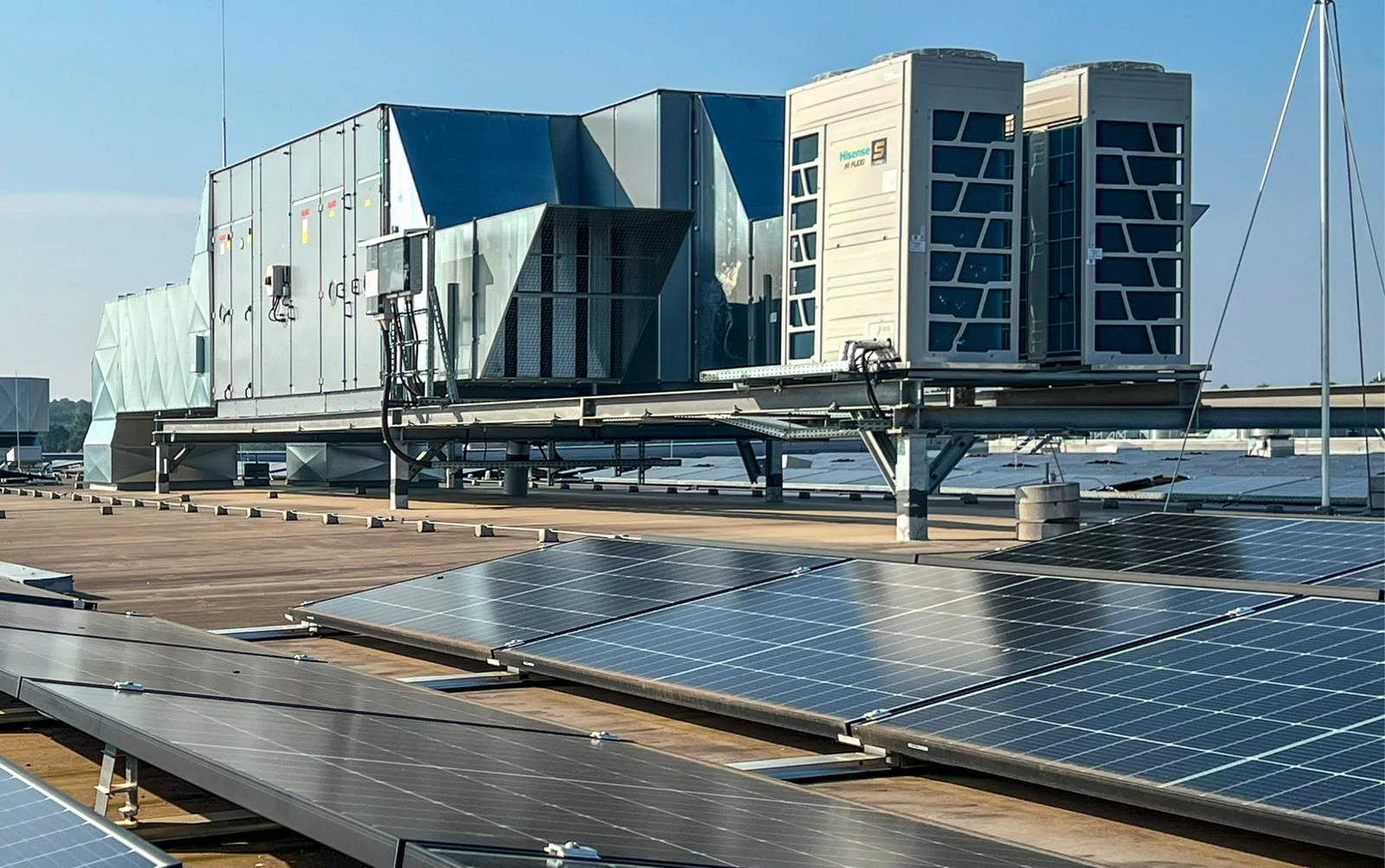
KKS Kälte & Klimasysteme GmbH has implemented one of Europe's largest Hisense VRF systems at a logistics complex: 80 outdoor units with a total capacity of 4,253 kW serve 35 air handling units with a combined air flow of approximately 1,088,500 m³/h. Electricity for the system is primarily supplied by a 28-MW photovoltaic power plant on the warehouse rooftops, enabling operation in a near CO₂-neutral mode.
Scale and Requirements
The warehouse complex is served by 35 AHU units with air volumes ranging from 16,000 to 72,000 m³. The key project requirement is a complete elimination of fossil fuels in favor of purely electric power from renewable sources. The building design — high ceiling heights, variable usage (storage, packing, transshipment), and varying thermal loads from dock doors and solar gain — required a modular and scalable AHU/VRF architecture with high efficiency and redundancy.
System Architecture
The AHUs are designed for specific volumetric flow rates and equipped with EC fans and high-efficiency rotary heat exchangers with integrated humidity and temperature control. Air thermal treatment is performed not through conventional heaters and coolers, but through direct connection of VRF systems.
For thermal conditioning, air-to-air VRF systems with direct evaporation are used. Outdoor units (models AVWT-190HKSS – AVWT-272HKSS) are installed in close proximity to the AHUs to minimize piping runs. Heat transfer to the air stream is handled by HZX evaporator packages:
- External heat exchanger power range: 1.5–95 kW
- Fine control: 0–10 V interface for dynamic control of setpoints and power
- System integration: built-in alarm contacts for operation and fault signals to the central BMS
This architecture provides zonal temperature control: energy is delivered precisely where it is needed. The project uses a total of 80 outdoor units and 80 HZX-30.0AEC control modules.
Outdoor Units in the Exhaust Air Stream
The central design solution of the project is the placement of VRF outdoor units in the AHU exhaust duct. Pre-conditioned exhaust air from the hall (around 20 °C) serves as the source for the outdoor units. This provides several benefits:
- Reduced defrost cycles: the units are not exposed to cold outdoor air, minimizing icing and stabilizing operation.
- Increased COP: the smaller temperature difference between the source (exhaust air) and the sink (hall air) significantly increases the coefficient of performance, especially during the heating season.
- Extended service life: reduced mechanical and thermal wear decreases maintenance volume and extends the service life of outdoor units.
Power Supply and Control
The 28-MW photovoltaic power plant feeds the warehouses' medium-voltage internal network and covers the majority of the VRF and AHU system demands. Surplus energy is fed into the grid or used for electric mobility. Pre-heating of outdoor units with exhaust air further reduces electricity consumption during the heating season.
Central control is managed through a BMS (GLT) with a fully integrated interface to all components: VRF outdoor units, HZX packages, AHUs, and PV monitoring. The system continuously tracks humidity and temperature, automatically switching between cooling, dehumidification, and heating modes. Power is dynamically adapted via the 0–10 V signal, and peak loads are smoothed — for example, during PV generation fluctuations. Freely programmable relay contacts provide comprehensive monitoring with operation and fault signals.
Results
In the first months of operation, high efficiency and precise control have been confirmed. The targeted use of exhaust air in winter and the PV connection significantly reduce operating costs.
The project was implemented by KKS Kälte & Klimasysteme GmbH; equipment supply was carried out by CP Kaut GmbH & Co. (Sebastian Wrobel, sales department).
www.kaut.de
ORIGINAL SOURCE
Die Kälte + Klimatechnik ↗Visit the original source for additional details.