Science & technology
Physics-based model shows drop-in low-GWP refrigerants cause performance penalties in scroll compressors
A new mechanistic scroll compressor model, validated with R290 and R454C, demonstrates that using these low-GWP refrigerants as drop-in replacements in an R410A-designed unit can lead to significant performance penalties due to vapour density mismatch. The framework, published in Applied Thermal Engineering, provides a basis for refrigerant-specific compressor redesign.
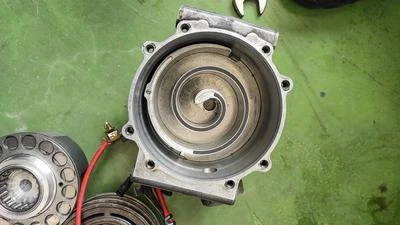
Simulations using a new physics-based scroll compressor model show that substituting R290 or R454C for R410A in an existing compressor geometry can lead to significant performance penalties, underscoring the need for refrigerant-specific design rather than simple drop-in replacement.
The challenge of the low-GWP transition
The ongoing shift toward lower-GWP refrigerants introduces new design constraints for compressor manufacturers. Differences in thermophysical properties between conventional and next-generation working fluids can significantly affect compressor capacity, efficiency, internal heat transfer, and leakage. As a result, replacing a conventional refrigerant with a low-GWP alternative may require adapting the compressor design to the new fluid's characteristics rather than relying on straightforward substitution.
A mechanistic modelling framework
A team of researchers, including Prof. Eckhard A. Groll (President of IIR Section B – Thermodynamics, Equipment and Systems), Prof. Haotian Liu (IIR private member), and Prof. Riley B. Barta (member of IIR Commission B2 – Refrigerating Equipment), developed and experimentally validated a physics-based scroll compressor model. The framework accounts for internal heat transfer, mechanical losses, and refrigerant leakage while incorporating the influence of compressor geometry and component-level behaviour. The model was initially validated against experimental data for R454C and R290 (propane). The approach aims to provide a more general modelling tool that can support the prediction and optimisation of compressor performance across different refrigerants.
Key finding: drop-in substitution is insufficient
Simulations with R290 and R454C demonstrated that using these refrigerants as drop-in replacements in a compressor originally designed for R410A can lead to significant performance penalties. The primary cause identified is the difference in vapour density, which creates a mismatch with the baseline compressor geometry. The results highlight the importance of moving beyond simple refrigerant substitution toward refrigerant-specific compressor design and optimisation.
Next steps
The researchers plan to use the experimental-numerical framework to investigate how the baseline compressor can be optimised for R290 and R454C and to quantify the resulting performance improvements. The approach could subsequently be extended to other next-generation refrigerants and compressor architectures, supporting the development of efficient equipment as the HVAC&R sector transitions toward lower-GWP working fluids.
Source:
[1] Parmar, Y. S., Motta, S. Y., Groll, E. A., Liu, H., Barta, R. B. (2026). Experimental and numerical framework for scroll compressor technology development for refrigerants with global warming potential < 150. Applied Thermal Engineering, Volume 304, Part 1, 2026, 132583. https://doi.org/10.1016/j.applthermaleng.2026.132583
ORIGINAL SOURCE
IIR: sector monitoring ↗Visit the original source for additional details.