Science & technology
Humidity's Impact on Cooling Performance Depends on the Heat-Transfer Mechanism
The effect of relative humidity on cooling equipment varies fundamentally between evaporative and conventional air-cooled systems. For evaporative coolers, dry air maximizes performance, while conventional condensers are rated primarily on dry-bulb temperature and airflow. Engineers should apply manufacturer-specified rating conditions and correction methods rather than assume a universal humidity effect.

By Eugene le Roux, FSAIRAC, and Eamonn Ryan
Whether relative humidity helps or hinders a cooling system depends on how that system transfers heat. The same ambient air that limits an evaporative cooler can be nearly irrelevant to a conventional air-cooled condenser.
Conventional air-cooled condensers
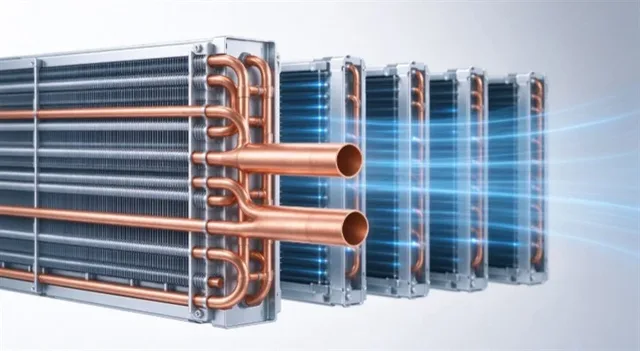
For dry air-cooled condensers and similar equipment that rejects heat to ambient air, performance is governed by ambient dry-bulb temperature, airflow, heat-exchanger design, and the temperature difference between the refrigerant and surrounding air. Relative humidity can shift air properties, but it is not the primary rating condition for a conventional dry condenser. Wet-bulb temperature, by contrast, becomes the key parameter when assessing evaporative and adiabatic heat-rejection systems.
Evaporative cooling
In evaporative cooling, water absorbs heat as it transitions from liquid to vapour. The process works most effectively when the surrounding air still has capacity to accept additional moisture, which is why dry air generally offers greater evaporative cooling potential than humid air. As air passes through a wetted medium, some of the water evaporates, lowering the air temperature while raising its moisture content. The process is approximately adiabatic — there is little net heat exchange with the surroundings — although real equipment incurs losses and other departures from the ideal. On a psychrometric chart the path follows a line of approximately constant enthalpy toward lower dry-bulb temperature and higher relative humidity.
This principle explains why evaporative coolers are particularly effective in dry climates.
Air-cooled engines
Air-cooled engines likewise require careful consideration of their design and operating conditions. It would be unsafe to assume that high humidity automatically improves their cooling performance. The effects of humidity, air density, combustion conditions, and any evaporative cooling mechanism need to be distinguished from one another.
Practical implications for testing and installation
A system assessed under one set of ambient conditions may behave differently in another climate. Engineers should therefore use the manufacturer's specified rating conditions and appropriate correction methods rather than rely on a general assumption about humidity. For HVAC&R contractors, the lesson is straightforward: understanding the psychrometric conditions surrounding equipment helps explain why performance changes with weather and location.
What comes next
In Part 4, the authors will examine how humidity's influence extends beyond cooling capacity — determining when condensation forms on buildings and equipment, how quickly wet surfaces dry, and why apparently minor moisture problems can become persistent maintenance issues.
Source: RACA Journal.
ORIGINAL SOURCE
RACA Journal ↗Visit the original source for additional details.