Science & technology
Narrowing Copper Tube Diameter to 4 mm: Xi'an Research Confirms 17% Cost Reduction Without Efficiency Loss
Professor Qian Suxin's team at Xi'an Jiaotong University presented findings at the 2026 China Home Appliance Technology Conference showing that optimizing a 1.5 HP outdoor heat exchanger from 5 mm to 4 mm tubes reduces copper cost by 17% and refrigerant charge by 95 g while maintaining heat exchange capacity and APF. The authors estimate that the 3–3.5 mm range may become the next critical threshold, though design and manufacturing complexity increases.
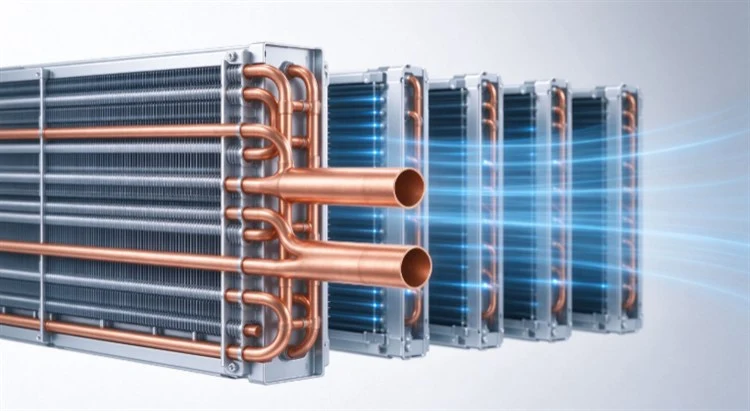
Professor Qian Suxin's team (Xi'an Jiaotong University) demonstrated at the 2026 China Home Appliance Technology Conference that transitioning the outdoor heat exchanger of a 1.5 HP air conditioner from 5 mm to 4 mm tubes reduces copper tube cost by 17% and refrigerant charge volume by 95 g, without reducing heat exchange capacity or the APF rating. The result was published on 4 November in the industry review Mysteel.
From 7 mm to 4 mm: context
Against the backdrop of persistently high copper prices, air-conditioner manufacturers are seeking ways to cut copper material consumption. Following the wave of "copper-to-aluminium substitution," a new direction has emerged: reducing tube diameter in heat exchangers. Standard 7 mm tubes have already been replaced by 5 mm tubes, and some research is now pushing toward 4 mm.
What the study actually did
For the outdoor heat exchanger of a 1.5 HP air conditioner, Professor Qian Suxin's team:
- increased the number of parallel channels;
- optimized flow distribution and flow-path geometry;
- matched compressor operating frequency to the new hydraulic regime.
While maintaining heat exchange capacity and APF, the team achieved: a 17% reduction in copper tube cost, a 95 g reduction in refrigerant charge, and a 50 mm reduction in heat exchanger height.
Technical limitations
Reducing tube diameter is not simply "making the tube thinner." Hydraulic resistance, refrigerant distribution uniformity, and heat exchange capacity all change. According to industry reviews, some models that formally meet APF requirements when moving from 7 mm to 5 mm show unsatisfactory heating performance at low ambient temperatures. Winter mode places higher demands on system-level coordination among the compressor, fan, and heat exchanger.
The study's authors note that, taking into account total pressure drop, heat exchange, flow-distribution complexity, and cost, the 3–3.5 mm interval may become the critical threshold for further development. Further narrowing of tubes implies growing complexity in design and manufacturing.
Editorial perspective
According to Refrigeration Express, narrowing copper tube diameter is a search for technological headroom to reduce unit cost under raw-material price pressure. This is not equivalent to "reducing specifications," but meeting APF does not guarantee an identical user experience across all models with small-diameter tubes. For the end user, the key factors remain overall energy efficiency, cooling and heating capacity, low-temperature performance, and long-term reliability. For manufacturers, the question is whether the material savings translate into a competitive product.
Source: Refrigeration Express.
ORIGINAL SOURCE
制冷快报 ↗Visit the original source for additional details.