Refrigerants & environment
NIST review traces why F-gases dominated refrigeration and what the shift to alternatives demands of system design
A 2026 review by NIST researcher Mark McLinden in the International Journal of Refrigeration examines the thermodynamic rationale behind the adoption of fluorinated gases and the engineering challenges that will accompany their phase-out. The paper argues that upcoming F-gas restrictions will reverse the traditional design approach: systems must be built around the properties of the chosen working fluid rather than the other way around.
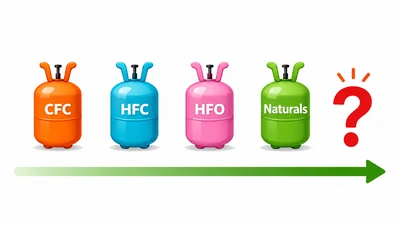
A review published by NIST researcher Mark O. McLinden in the International Journal of Refrigeration (2026) argues that the coming restrictions on fluorinated gases will force a fundamental reversal in how refrigeration systems are engineered: instead of selecting a refrigerant to fit an existing design, engineers will increasingly have to build the system around the thermodynamic and safety properties of the chosen working fluid.
Why fluorinated gases took hold
The development of halogenated refrigerants in the 1930s was a major safety advance, replacing the flammable or toxic working fluids that had been common up to that point. Their adoption was further supported by favourable thermodynamic characteristics that made them well suited to conventional vapour-compression cycles.
McLinden highlights that fluorine plays a dual role in refrigerant performance. Beyond reducing flammability, varying the fluorine content of a molecule allows its thermodynamic properties to be tuned to the requirements of different applications. This flexibility underpinned the development of a broad range of refrigerants offering different combinations of operating pressures, refrigeration capacities and efficiencies.
What is driving the transition
Environmental concerns are tightening the regulatory window on F-gases. The high global warming potential (GWP) of hydrofluorocarbons (HFCs) and the formation of persistent atmospheric degradation products such as trifluoroacetic acid (TFA) from some low-GWP hydrofluoroolefins (HFOs) are pushing increasingly stringent restrictions on the use of fluorinated gases.
Challenges of the alternatives
The review notes that each candidate replacement carries its own set of technical constraints:
- Ammonia (R717) – toxicity concerns require careful handling and containment.
- Carbon dioxide (R744) – non-flammable and of low toxicity, but operates at high pressures and often demands transcritical cycles and more sophisticated control strategies.
- Hydrocarbons, including propane (R290) – highly flammable, requiring appropriate safety measures and refrigerant charge limitations.
Design implications
According to McLinden, the narrowing range of available refrigerants will mean that modified refrigeration cycles, advanced heat-exchanger designs and adapted compressors become necessary to maintain efficiency and ensure safe operation. The transition, he concludes, is technically feasible but will require continued innovation in refrigeration system design to accommodate the thermodynamic and safety characteristics of alternative refrigerants.
The paper is available in open access in the International Journal of Refrigeration.
Source: McLinden, M. O. (2026) "Thermodynamic of refrigerants: Or why did we ever go with the F-gases?" International Journal of Refrigeration 190 (2026) 107033. https://doi.org/10.1016/j.ijrefrig.2026.107033
Also: IIR sector monitoring.
ORIGINAL SOURCE
IIR: sector monitoring ↗Visit the original source for additional details.