Refrigerants & environment
EPA revises Technology Transitions Rule: retail food and cold storage GWP deadlines shift to 2032 amid tightening HFC supply
The revised rule permits HFC-based equipment with GWP below 1,400 in retail food and cold storage through 2032, while the AIM Act phasedown will cut U.S. HFC production and consumption to 70% of baseline by 2029 and 85% by 2036. EPA analysis projects that HFC demand will exceed available allocations starting in 2029, and international experience shows legacy HFC prices rose over 1,000% in Europe and nearly tripled in Australia after quota reductions.

The EPA's revised Technology Transitions Rule, published in June 2026, pushes key global warming potential (GWP) compliance deadlines for the retail food and cold storage sectors to 2032. The update, which modifies the agency's 2023 Technology Transitions Rule, allows the continued installation of HFC-based equipment with a GWP below 1,400 — most likely R-448A or R-449A — for another five to six years in most affected categories. At the same time, the concurrent HFC phasedown under the American Innovation and Manufacturing (AIM) Act is narrowing the supply window for those very refrigerants.
What the revised rule specifies by sector
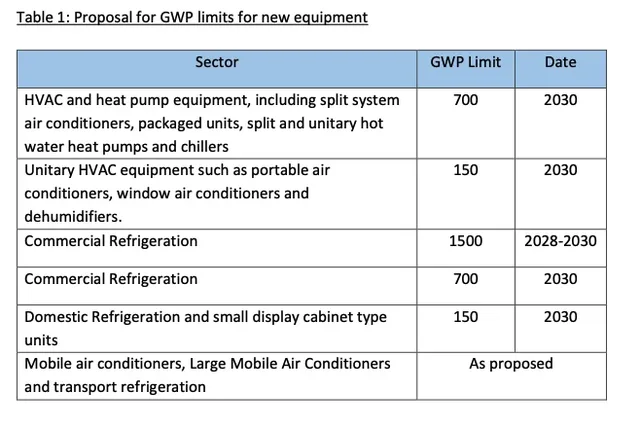
The ruling sets the following GWP limits for new equipment:
- Retail food, supermarket racks: 1,400 GWP from January 1, 2027; 150–300 GWP from January 1, 2032 (depending on charge size).
- Retail food, condensing units: 1,400 GWP from July 27, 2026; 150–300 GWP from January 1, 2032.
- Cold storage warehouse equipment: 700 GWP from July 27, 2026; 150–300 GWP from January 1, 2032.
The 150 GWP threshold applies to systems with refrigerant charges of 200 lbs. or more; the 300 GWP threshold applies to systems with charges of 200 lbs. or less. These charge-size boundaries may influence a retailer's choice between large centralized architectures and smaller distributed or self-contained systems.
The rule also permits supermarket systems to increase cooling capacity by up to 15% — for example, adding a new display case — without the modification being classified as a new system installation.
HFC supply pressure and what other markets have shown
Under the AIM Act, consistent with the Kigali Amendment to the Montreal Protocol, U.S. HFC production and consumption will be reduced to 70% of baseline levels by 2029, with a further 50% cut in that phase, culminating in an 85% reduction by 2036. In a memo analyzing the economic and environmental impacts of reconsidering the Technology Transitions Rule, the EPA noted that additional demand for HFCs could result in tighter supply and higher prices for downstream consumers. The agency's analysis also indicated that HFC demand would exceed the amount available to allocate beginning in 2029 if no other actions were taken.
International experience underscores the risk. Since quotas were reduced in Europe, legacy HFC refrigerant prices rose by over 1,000%. In Australia, where the government introduced legislation in 2017 to phase down high-GWP refrigerants, HFC prices nearly tripled over a few years amid continued supply shortages. Smaller, independent retailers were the least equipped to absorb those supply reductions and pricing shocks. Australian stakeholders had continued to purchase and use equipment with legacy refrigerant technologies, which ultimately contributed to the shortfalls now observed.
Service and operational challenges through 2032 and beyond
Installing new HFC systems through 2032 creates servicing challenges that can persist for the full system lifecycle, potentially up to 20 years or more. Key questions include whether sufficient R-448A/R-449A supply will be available to meet demand over the next two decades, whether reclaimed HFC refrigerant will be findable for service, and how much prices will rise.
Centralized, direct-expansion refrigeration systems leak on average at 20% annually. In a context where HFC supplies are limited and production of virgin HFC refrigerant is banned, refrigerant leak detection, reclaim, and recovery strategies will no longer be optional. Retailers using these systems will need a plan to maintain adequate supply levels for servicing, with increased documentation and record-keeping required for compliance.
Lower-GWP readiness and cross-sector effects
Although the federal transition timeline has been extended, 2032 is only a few years away, and states with their own HFC rules — including California, Washington, and New York — still require compliance with existing refrigerant mandates. Many large and small retail chains have pledged sustainability goals that will drive transitions to lower-GWP refrigerants regardless of shifting federal timelines.
Sustainable solutions are already available for self-contained refrigeration, condensing units, and both centralized and distributed architectures. CO2 and R-290 have been in commercial use for more than a decade and continue to advance across a wide range of application scenarios. A2L solutions have recently emerged, offering lower-GWP options and scalability across multiple architectures. Increased adoption, technological progress, and production economies of scale are making first costs more competitive for lower-GWP systems, with potentially lower lifecycle costs driven by improved system efficiencies and the certainty of future refrigerant availability.
Beyond first costs, retailers need to evaluate long-term serviceability and operating costs across the system lifecycle, both of which will be affected by refrigerant availability and cost.
The extended use of HFC equipment below 1,400 GWP in commercial refrigeration could also introduce unintended consequences for other sectors. R-448A, with a GWP of 1,387, has roughly a 90% higher GWP than available low- or ultra-low-GWP alternatives. Prolonged use could deplete the available HFC quota at a much higher rate, tightening overall supplies and potentially affecting the residential and light commercial HVAC sector. The EPA expected that greater HFC demand in the affected subsectors would have indirect effects on HFC prices and usage, including for other subsectors not directly affected by the rulemaking, due to the finite and decreasing amount of HFC production and import governed by the AIM Act phasedown schedule. This could increase the likelihood of another refrigerant transition in air conditioning, involving fluid options that introduce new capacity, pressure, and flammability challenges.
Jennifer Butsch, Senior Director of Regulatory Affairs at Copeland, authored the analysis. Copeland has more than a decade of experience working with retail and manufacturing partners on CO2 (R-744), R-290, and A2L equipment technologies for self-contained, distributed, and centralized architectures.
Source: Copeland Newsroom.
ORIGINAL SOURCE
Copeland Newsroom ↗Visit the original source for additional details.