Refrigerants & environment
Australian Industry Proposes Phased GWP Limits for New Refrigeration and HVAC Equipment to Government
Refrigerants Australia and AREMA have submitted a draft GWP limits proposal to the Australian government, proposing 2030 as the key effective date for most equipment categories. Compared with the EU F-gas Regulation, the proposed pathway is more gradual, particularly in the commercial refrigeration segment.
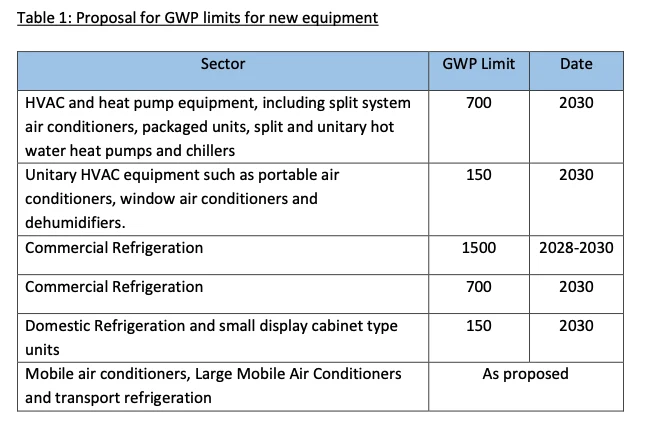
On 28 October 2026, industry associations Refrigerants Australia and AREMA (Air-Conditioning and Refrigeration Equipment Manufacturers Association of Australia) announced the submission of a new proposal to the Australian government on GWP limits for refrigerants in new equipment. The document sets specific thresholds for refrigeration equipment, air-conditioning systems, and heat pumps, with 2030 put forward as the primary effective date for most categories. A key caveat is emphasised: these are the associations' requirements, not already enacted regulations.
Specific GWP Thresholds by Category
- Commercial refrigeration equipment: a limit of 1,500 during the 2028–2030 period, then 700 from 2030 onward. The interim step is justified by the need to curb the introduction of new equipment on R404A; R448A and R449A are named as available alternatives.
- Domestic refrigeration and small display cases: a threshold of 150 from 2030.
- Air conditioning and heat pumps (split systems, monoblock units, hot-water heat pumps, chillers): a limit of 700 from 2030. The associations note that this level would allow continued use of R32, R513A, and R454B.
Rationale: HFC Quotas and Adaptation Timelines
The proposal is grounded in an analysis of the relationship between HFC import reductions and the needs of the installed base. According to an annex to the document, R404A and R410A represent the main supply risks in the short term. The associations assess that continued installation of high-GWP refrigerant equipment will sustain demand for many years, while available quotas are shrinking.
At the same time, Refrigerants Australia and AREMA insist that the transition should not be excessively rapid. The preference for 2030 over 2028 is explained by several factors: existing stockpiles of equipment, already signed contracts, testing and production-line modification timelines, and the need to prepare technicians for work with flammable, toxic, or high-pressure refrigerants.
Comparison with the EU Regulation
The F-gas Regulation (EU) 2024/573 already establishes, from 2030, a ban on placing on the market refrigeration equipment falling under point 5 of Annex IV when using fluorinated gases with GWP ≥ 150, except in cases dictated by safety requirements. For standalone commercial refrigerators and freezers, the ban on HFCs with GWP ≥ 150 has been in effect since 2022, and from 2025 it has been extended to other fluorinated gases.
The categories in the two documents do not fully align; however, the Australian proposal in the commercial refrigeration segment builds a more gradual trajectory, preserving room for interim refrigerants compared with the EU thresholds.
The proposal fits within the broader international transition to lower-GWP refrigerants. The key challenge common to all markets reducing HFC volumes is to align supply reductions with the renewal of new equipment while ensuring that servicing of the installed base is not disrupted.
Source: ZeroSottoZero.
ORIGINAL SOURCE
ZeroSottoZero ↗Visit the original source for additional details.