Science & technology
Desiccant Dehumidifiers: Separating Moisture from Temperature in Green Building Cooling
Desiccant dehumidifiers decouple latent and sensible cooling loads, allowing green buildings to regenerate desiccant materials with solar heat or industrial waste heat instead of grid electricity. The technology addresses the building sector's projected 122% increase in electric energy consumption by 2030 while supporting Net-Zero Energy Building criteria in hot and humid climates.
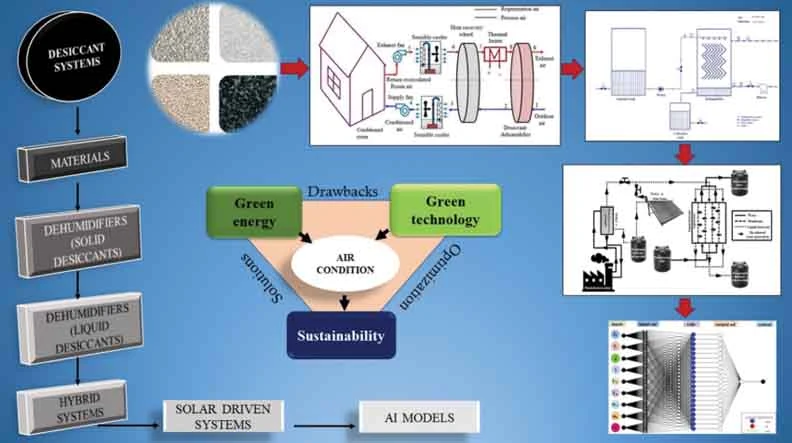
Desiccant dehumidifiers separate moisture removal from sensible cooling, enabling green buildings to regenerate desiccant materials using low-grade thermal energy—solar heat or industrial waste heat—rather than grid electricity. By decoupling latent and sensible loads, these systems can improve the thermal coefficient of performance in hot and humid climates while supporting Net-Zero Energy Building (NZEB) criteria.
The energy challenge in buildings
The building air-conditioning sector accounts for more than 60% of energy consumption in commercial and industrial buildings, supporting electrical appliances, thermal comfort from traditional air conditioners, and lighting. As global population grows, urbanisation advances, and living standards rise, sector electric energy consumption is projected to increase by 122% from 2002 to 2030. Conventional vapor-compression refrigeration (VCR) systems handle both sensible and latent loads by cooling air below its dew-point temperature. This approach can result in unnecessary sensible cooling, condensation, and subsequent reheating, increasing compressor energy consumption—particularly in hot and humid climates where both temperature and humidity must be controlled.
How desiccant dehumidification works
A desiccant is a hygroscopic material that attracts and retains water vapour from surrounding air. When humid air contacts the desiccant, moisture transfers from the air to the material due to a difference in water-vapour pressure, reducing the air's humidity ratio. The absorption or adsorption process releases heat, so the dehumidified air is typically passed through a cooling coil to reach the desired indoor temperature. Once saturated, the desiccant is regenerated by supplying heat, which drives the absorbed moisture out into a separate regeneration air stream, restoring the material's capacity for the next cycle.
Desiccant systems are broadly classified into two types:
- Solid desiccant systems use materials such as silica gel, zeolites, and other porous hygroscopic substances. The rotary desiccant wheel is the most widely used configuration: the wheel rotates slowly between a process air stream (from which moisture is removed) and a heated regeneration air stream (which restores the desiccant's moisture-absorbing capacity). In a typical unit, the heater temperature is maintained at approximately 55–68 °C, and moisture is carried out of the room via ductwork.
- Liquid desiccant systems use hygroscopic solutions such as lithium chloride or lithium bromide to absorb moisture. The diluted solution is heated in a regeneration unit to release water vapour and restore its concentration.
Performance of both types depends on material properties, operating temperature, airflow rate, and regeneration conditions.
Role in sustainable building cooling
When a desiccant dehumidifier is installed before the cooling coil in an HVAC system, a major portion of moisture is removed independently, and the cooling coil primarily handles the sensible load. Under suitable operating conditions, this arrangement can reduce compressor energy consumption and improve overall system performance. Hybrid desiccant–vapor-compression systems combine the reliable cooling capacity of conventional refrigeration with independent humidity control and have been identified in research reviews as an important development in energy-efficient building cooling.
Desiccant systems also support healthier indoor environments by controlling moisture independently, reducing the risk of condensation and mould growth. This is particularly relevant in hospitals, laboratories, educational institutions, offices, and hotels, where indoor conditions must remain within defined limits. The technology can also treat outdoor ventilation air before it enters occupied space, managing moisture introduced through ventilation while maintaining indoor air quality—provided it is combined with suitable ventilation, filtration, and temperature control.
Integration with renewable and waste-heat sources
Regeneration requires thermal energy, and this is where desiccant systems gain a sustainability advantage. Solar thermal collectors can supply the heat for regeneration, making solar-assisted desiccant cooling attractive in regions with good solar availability. Waste heat from industrial processes, refrigeration equipment, and other building systems can also be used when the available temperature is suitable. In green building design, desiccant dehumidifiers can be integrated with solar photovoltaic systems, solar thermal collectors, energy-efficient cooling equipment, and building automation. Temperature and humidity sensors regulate the dehumidifier, regeneration heater, fans, and cooling coil according to actual building requirements, avoiding unnecessary operation. Thermal energy storage may be incorporated to hold available heat for regeneration when solar radiation is insufficient. However, the energy required for regeneration, air circulation, and auxiliary equipment must be assessed carefully; a system consuming excessive regeneration energy may not deliver the expected environmental benefits even with an efficient dehumidification process.
Applications and environmental considerations
Desiccant dehumidifiers can be applied in residential complexes, commercial offices, educational campuses, healthcare facilities, hotels, and industrial buildings. In humid climates they are particularly useful for treating fresh outdoor air and reducing the burden on conventional cooling equipment in buildings with high latent loads. Lower electricity consumption can reduce operational carbon emissions where the electricity supply has significant carbon intensity, and the use of solar heat or recovered waste heat for regeneration provides additional environmental advantages. These benefits depend on overall system design, the source of regeneration energy, cooling equipment efficiency, and local climatic conditions.
For green buildings in India, desiccant dehumidification has considerable potential because many regions experience high outdoor temperatures and seasonal humidity variations. In coastal and humid regions of Gujarat, the combination of high temperature and moisture increases cooling and dehumidification requirements. A hybrid system using a solid desiccant wheel, an efficient cooling coil, and solar-assisted regeneration may provide an effective solution for suitable applications, with design considerations including seasonal weather, ventilation requirements, operating schedules, and renewable thermal energy availability.
Challenges and research directions
Despite their advantages, desiccant dehumidifiers face technical and economic challenges. The regeneration process requires a reliable thermal energy source, and overall performance decreases if this energy is supplied inefficiently. Initial equipment, installation, and control-system costs may exceed those of conventional air-conditioning systems. Desiccant materials must maintain moisture-removal capacity over repeated cycles; solid systems require effective sealing and airflow distribution, while liquid systems need measures to prevent corrosion and solution carryover. Further research is needed to develop advanced desiccant materials with high moisture capacity, rapid moisture transfer, low regeneration temperature, and long-term durability. Integration of artificial intelligence, advanced sensors, thermal energy storage, and renewable energy systems also offers opportunities to improve the efficiency and reliability of desiccant-assisted cooling.
The article was written by Dr. (Prof.) D.B. Jani, Associate Professor at GEC, Bhavnagar, Gujarat Technological University (GTU), Ahmedabad, India. He holds a Ph.D. in Thermal Science (Mechanical Engineering) from IIT Roorkee and has published more than 300 research articles, 25 books/book chapters, and patents in thermal engineering. His research areas include desiccant cooling, ANN, TRNSYS, and exergy analysis.
Source: Cooling India.
ORIGINAL SOURCE
Cooling India ↗Visit the original source for additional details.