Chillers & heat pumps
Ajin P&P: 1000 RT Industrial Heat Pump Converts Waste Heat from Paper Production into 120 °C Steam
Ajin P&P is commissioning a 1000 RT-class industrial heat pump on an active paper production line: the system recovers waste heat at 60–65 °C and is designed to produce steam above 120 °C at a rate of approximately 5.5 t/h. The project is supported by KETEP in 2023–2027; with full coverage of waste heat, the estimated annual LNG savings are 2.4 billion won.
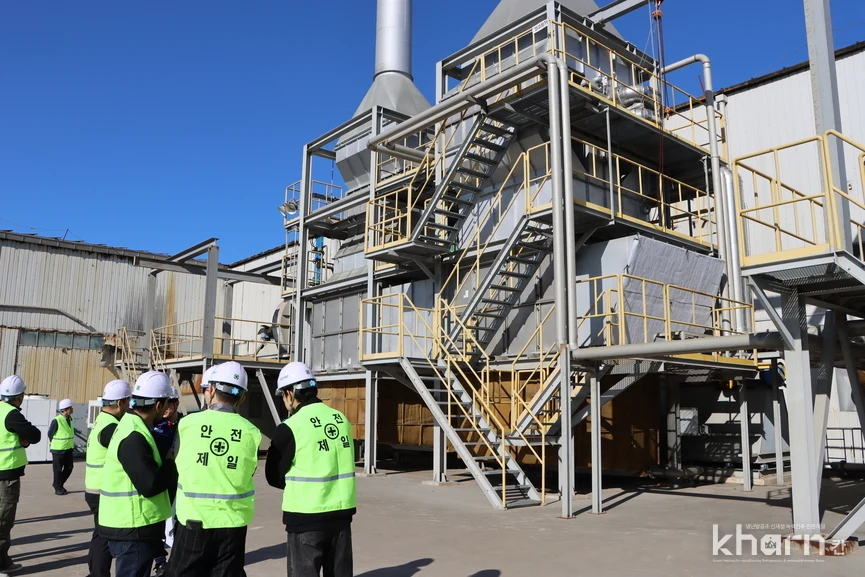
Ajin P&P is commissioning a 1000 RT-class industrial heat pump integrated into an active paper production line. The system recovers waste heat at 60–65 °C and is designed to produce steam above 120 °C at a rate of approximately 5.5 t/h; the heat pump's coefficient of performance (COP) displayed on the shop-floor monitor reads approximately 3.5.
Project and company role
The installation is being developed under the KETEP (Korea Energy Technology Evaluation and Planning) programme "Development of key technologies and commissioning and operation technologies for a 1000 RT-class industrial heat pump with a large temperature lift." The project started in 2023 and is scheduled to run through 2027. Its goal is to master the technology for recovering low-temperature waste heat from industrial processes and converting it into high-temperature thermal energy. Ajin P&P is responsible for building the demonstration equipment in the paper mill, integrating it with the existing production line, optimising operating modes, and collecting operational data.
Configuration and parameters
The system is built on a cascade configuration:
- a waste heat recovery heat exchanger (Waste Heat HX) heats the heat transfer fluid from ~38 °C to ~43 °C;
- a low-temperature and a high-temperature heat pump raise the temperature to ~103–108 °C;
- a steam generator, using water from the reverse osmosis unit, produces steam;
- a mechanical vapour recompression (MVR) unit brings the steam pressure and temperature to operating values.
The final output is steam above 120 °C, approximately 5.5 t/h. The system operates in parallel with the existing low-pressure steam network: it receives both heat-pump-generated steam and re-evaporated steam from the main process, so operating modes account for pressure fluctuations depending on steam volume.
Specifics of paper production
The paper industry is one of the most energy-intensive sectors: the paper-drying process consumes large quantities of steam, and a significant portion of thermal energy is lost with exhaust gases. At the Ajin P&P site, paper with a basis weight of 90–300 g/m² is produced. Depending on the product type and season, steam consumption varies: in a typical mode it is approximately 28 t/h, while during high-basis-weight paper production or in winter it reaches 38–40 t/h. The supply pressure in the existing steam network also depends on conditions: ~6 bar for high basis weight, ~4 bar for low basis weight.
This is why, according to Ajin P&P, an industrial heat pump requires not only high efficiency but also stable integration with the existing steam system.
Current status and monitoring
At present, the system is in the short-duration startup testing phase, aimed at verifying performance and stability. By calculation, with a heat transfer fluid at 43 °C and an output of 120 °C / 5.5 t/h, the target integrated COP is 2.56. The shop-floor monitor displays in real time the temperature, pressure, flow rate, energy consumption, and COP of each unit.
An Ajin P&P representative stated that in the initial phase, the steam generator was controlled by water level, but flow-rate fluctuations affected overall performance; a mode that accounts for both level and flow rate is now applied.
Scaling prospects
The demonstration unit currently uses approximately one-third of the paper mill's waste heat. According to the company's estimate, with full coverage of waste heat through additional heat pump installation, energy savings could increase by roughly threefold compared to the current plan, and annual LNG savings would be approximately 2.4 billion won. However, scaling requires a comprehensive assessment of initial investment, operational efficiency, integration with the existing line, equipment maintenance, and changes in thermal demand across process stages.
Ajin P&P plans to conduct continuous operation through 2027, verify long-term efficiency, economic benefit, and payback, and refine operating modes adapted to the specific industrial process. A company representative emphasised that applying a heat pump at a paper mill requires developing technologies suited to real operating conditions, and added that if the stability and economic efficiency of a large-capacity industrial heat pump are confirmed, the project could help expand the electrification of process heat in energy-intensive industries, including the pulp and paper industry.
ORIGINAL SOURCE
Kharn ↗Visit the original source for additional details.