Science & technology
Cascade R290/R170 study pinpoints exergy losses at −80 °C
A November 2026 Scientific Reports study models a steady-state cascade refrigeration subsystem using propane R290 and ethane R170 at −80 °C evaporation. Compressors account for 35.2% of total exergy destruction, with the cascade heat exchanger contributing 24%, identifying key targets for efficiency improvement.
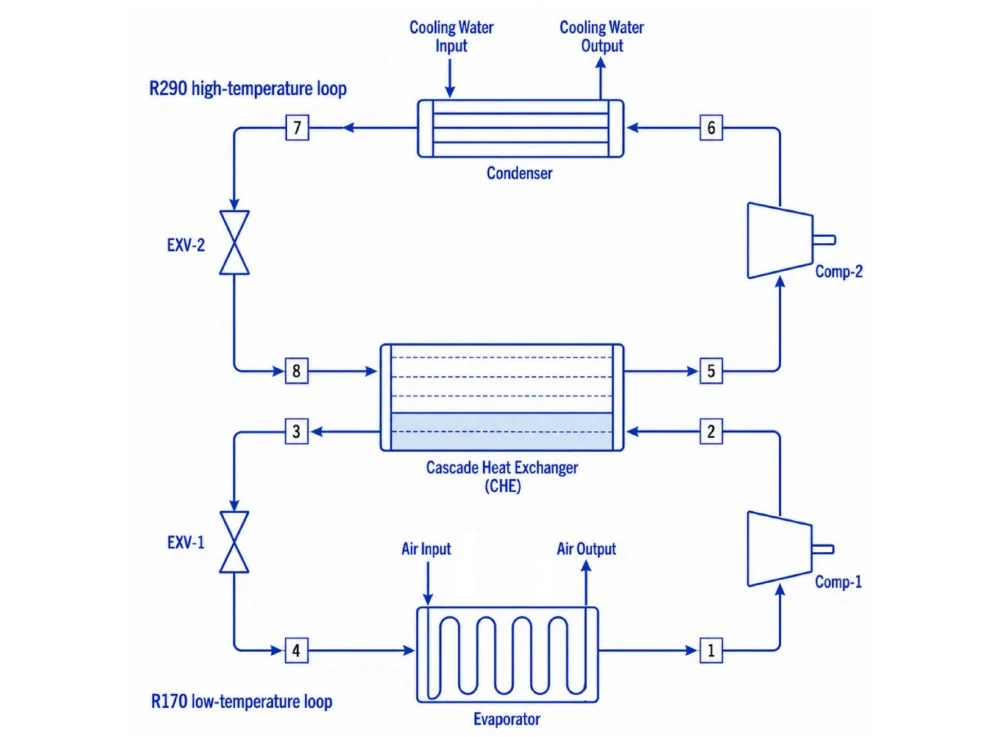
A study published in Scientific Reports in November 2026 presents a steady-state exergy analysis of a cascade refrigeration subsystem designed for ultra-low-temperature operation. The model pairs propane (R290) in the high-temperature circuit with ethane (R170) in the low-temperature circuit and quantifies where irreversibilities concentrate under a defined operating point.
Key model parameters and results
- Cooling load: 5 kW
- Evaporation temperature: −80 °C
- COP: 0.6035
- Electrical input: 8.285 kW
- Exergy destruction share — compressors: 35.2%
- Exergy destruction share — cascade heat exchanger: 24%
The authors use these figures to highlight compressor design and cascade heat-exchanger performance as the primary levers for reducing thermodynamic losses in this class of system.
Scope and caveats
The work is a simulation of a subsystem, not a demonstration of a complete storage installation. Storage sizing, material selection, and transient charging or discharging behaviour were outside the modelled scope. Both R290 and R170 are flammable refrigerants; the authors note that any practical deployment would require application-specific safety engineering.
ORIGINAL SOURCE
Refindustry ↗Visit the original source for additional details.