Markets & companies
Ecolab Korea Unveils Integrated Liquid Cooling Solution for AI Data Centers at DATA CENTER KOREA 2026
At DATA CENTER KOREA 2026 (Nov 4–6, Seoul), Ecolab Korea showcased an end-to-end liquid cooling system for AI data centers, combining CoolIT Systems D2C hardware with water treatment and digital monitoring. The company also proposed a CaaS model to optimize total cost of ownership.
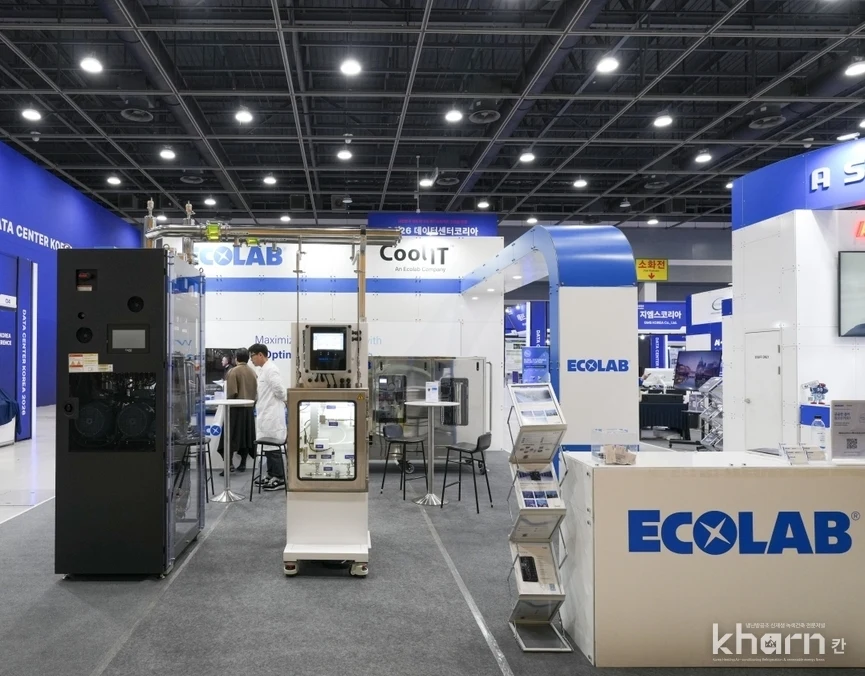
Ecolab Korea (CEO Ryu Yang-Kwon) presented an integrated liquid cooling solution for AI data centers (AIDC) and their operational strategy at DATA CENTER KOREA 2026, held November 4–6 at the aT Center in Seoul. The key message of the booth was the phrase «Liquid Cooling. All In.™».
The exhibition, organized by the Korea Engineering Systems Association and Messe ISE, was the first specialized industrial trade show in the data center sector in Korea. It featured cooling systems, network and power infrastructure, energy management solutions, and DCIM.
From Chip to Data Center Infrastructure
Ecolab Korea's solution covers the full cycle: from D2C (Direct-to-Chip) cooling at the individual chip level to managing the entire data center cooling infrastructure. It includes a liquid cooling hardware platform acquired together with CoolIT Systems, coolant quality management, water treatment, and digital monitoring. Booth visitors showed interest in the impact of contamination and coolant property changes on system stability, methods of managing operational risks, maintenance efficiency, and the applicability of solutions in real data center conditions.
CaaS Model and Technical Presentations
On November 5, during the DC Tech session, leaders of Ecolab Korea's High-Tech division (Vice President and Executive Director Kwon Min-Joon) delivered a presentation titled «Shifting the Paradigm of AI Data Center Cooling: CaaS and Response to New Regulatory Requirements.» They described the Cooling-as-a-Service model, in which the design, construction, operation, and maintenance of cooling infrastructure are delivered as a single service, enabling optimization of total cost of ownership (TCO) and improved predictability of operational expenses.
On November 6, at the global conference, Ecolab Korea's Data Center Group Director Song Jong-Seok presented «The Evolution of AI Data Center Liquid Cooling: From Cold Plate to Cooling Loop Optimization.» He outlined the development directions of D2C technologies amid growing AIDC density and increasing GPU heat output, and described the interaction between cold plates, coolant distribution units (CDU), and technological cooling system (TCS) components, as well as the role of coolant quality control and digital monitoring in ensuring system stability and efficiency.
Context: CoolIT Acquisition and Global Presence
In July, Ecolab completed the acquisition of CoolIT Systems — a specialized manufacturer of liquid cooling for AI data centers. This enabled the company to complement its water treatment and digital monitoring competencies with liquid cooling hardware technologies. According to the company, Ecolab serves more than 800 data centers worldwide and collaborates with 9 of the top 10 hyperscale data center operators globally. Among partnership areas — joint work with NVIDIA on coolant condition verification and monitoring, cooling infrastructure development, and next-generation technologies for AI factories.
Ryu Yang-Kwon noted that with the accelerating increase in AI data center density and performance, ensuring the stability and efficiency of cooling systems is becoming increasingly critical. In his words, Ecolab Korea provides an integrated solution covering liquid cooling hardware, coolant quality control, digital monitoring, and maintenance, and intends to actively contribute to the stable operation and improved cooling efficiency of domestic AI data centers.
ORIGINAL SOURCE
Kharn ↗Visit the original source for additional details.