Markets & companies
Danfoss Ships Its Transcritical CO₂ Training Complex Abroad for the First Time, Expanding Deployment in China
In January, Danfoss delivered a transcritical CO₂ training complex to China — the first time the system has left its European headquarters as part of a global tour. Simultaneously, the company is scaling its combined cooling and heating technology across food processing, pharmaceutical logistics, retail, and export segments.
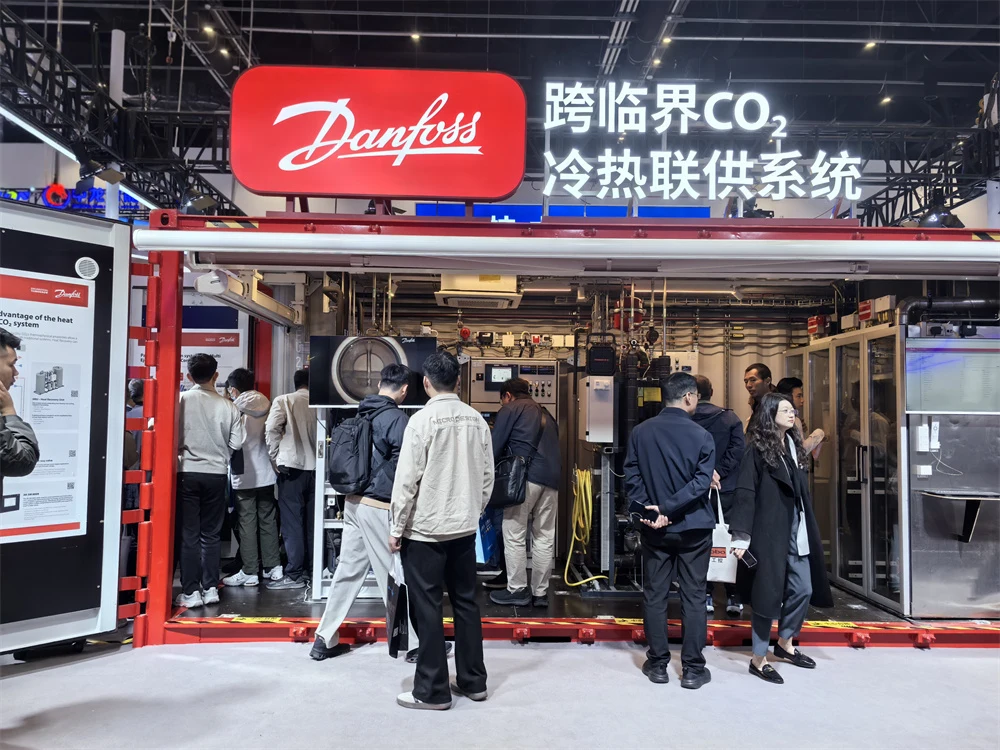
In January, Danfoss brought a transcritical CO₂ training complex to China, manufactured at its European headquarters. According to Yang Yang, Business Development Manager at Danfoss Climate Solutions, this is the first time the equipment has been shipped outside Denmark: China is the first stop on a global tour, with the complex set to travel next to South Korea and Australia.
Training Complex and Workforce Development
Yang Yang emphasises that the complex is not a component display but a fully operational system: it integrates a compressor, valves, piping, and a complete set of electronic control systems. The key feature is the demonstration of combined cooling and heating: the system stably produces steam at temperatures above 100 °C, allowing trainees to directly observe and service the high-temperature heat-transfer circuit. The complex replicates the logic of real engineering solutions — high pressure, piping layout, pressure control — and is equipped with Danfoss's own unit control system, which, according to Yang Yang, addresses the industry-wide problem of CO₂ system incompatibility with standard PLC programming.
A version of the training complex adapted to Chinese conditions will, according to the company, be commissioned in the fourth quarter of the current year. Danfoss has also, together with the China Refrigeration Society, Tianjin University of Commerce, and the Tianjin Refrigeration Society, developed a specialist training programme covering everything from theoretical fundamentals and design to installation and operation.
Danfoss has been present in the Chinese market since 1996; the country hosts 12 manufacturing sites, several applied R&D centres, and a global refrigeration test centre.
Market Context and Target Segments
According to Yang Yang, the cold storage market will continue steady growth this year, but the growth logic has fundamentally shifted: extensive expansion has given way to segment specialisation and "green" quality improvement. On the policy side, the Ministry of Ecology and Environment is tightening controls on high-GWP refrigerants as part of its carbon strategy; the transition to natural refrigerants is becoming a mandatory requirement rather than an option.
Among the key market challenges identified by Danfoss: an oversupply of standard cold storage facilities against a shortage of high-value-added assets; high barriers to refrigerant replacement and system upgrades for small and medium enterprises; a wide spread in energy efficiency levels; and unmet demand for multi-zone, high-precision, and combined (cooling + heating) solutions.
Transcritical CO₂ technology is finding application in several segments:
- Ready meals: industry growth is driving demand for integrated storage, processing, and delivery solutions with multi-zone precise temperature control;
- Pharmaceutical logistics: strict regulatory requirements and high-precision temperature control make CO₂ systems the preferred choice for storing and manufacturing pharmaceutical products;
- Food processing: slaughterhouses and central kitchens need both low-temperature storage and large volumes of high-temperature heat simultaneously — a transcritical combined cooling and heating system meets both needs with a single unit;
- Retail and export: demand is growing for compact, energy-efficient, and low-noise solutions for retail locations; for export to Europe, where the GWP threshold is capped below 150, CO₂ (GWP = 1) is becoming the standard refrigerant for mobile refrigeration equipment, bus air conditioning, and export cold storage.
Practical Results
Among completed projects, Yang Yang highlights the Tianhong supermarket in Changsha — one of the first major Chinese retailers to switch to a fully transcritical CO₂ system. According to actual operational data, the system delivers approximately 17 % energy savings compared to a conventional fluorocarbon scheme at a manageable total cost of ownership. A number of transcritical CO₂ projects are planned for the Sam's Club chain this year.
Yang Yang compares the development of transcritical CO₂ technology to medicine: the theoretical foundation was built in Europe and the US, but large-scale practical implementation and experience accumulation are happening in China, where market volume, scenario complexity, and project density significantly exceed European levels. In her words, the experience gained in China is already being used by Danfoss's European teams as a reference.
In the context of refrigerant evolution — from early working fluids through R22 and R410A to natural refrigerants and the fifth generation of environmentally friendly substances — Yang Yang notes that each replacement cycle is accompanied by a comprehensive industry upgrade. Danfoss, she says, is working in three directions: cost reduction, standards development, and workforce training, so that green technology is implemented in real engineering projects.
This article is based on a publication in Refrigeration Business (制冷商情), 15 April 2026.
ORIGINAL SOURCE
制冷快报 ↗Visit the original source for additional details.