Standards & safety
Exhaust Gas Exhaust System for Backup Generators: A Hidden Reliability Factor in Data Centers
Exhaust gas exhaust from backup diesel generators in data centers is a component that becomes critical only upon failure. A poorly designed system can lead to toxic gas leaks, excessive back pressure, or thermal damage, threatening service continuity. The article covers six key design requirements, temperature ranges (500–600 °C), sealing criteria, and commissioning procedures.
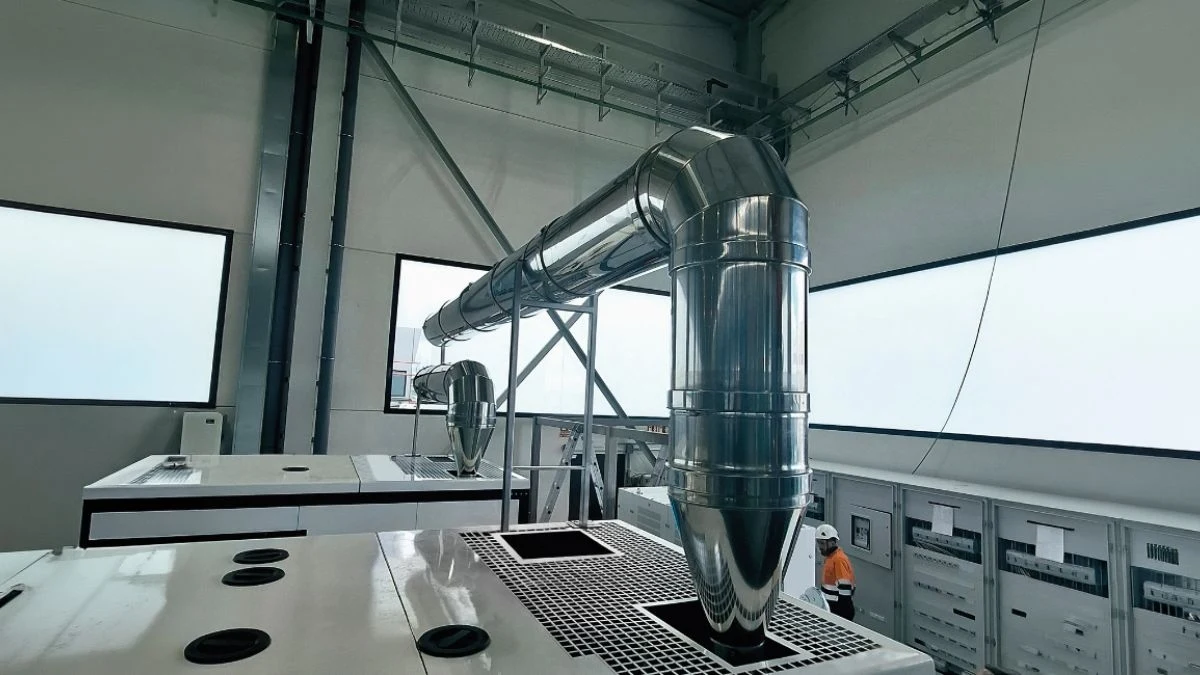
The Invisible Link in the Redundancy Chain
Data centers keep financial services, telecommunications, e-commerce, government systems, healthcare, and AI-based applications running. When the grid goes down, backup generators take over the load, and their start-up allows not a second of delay. However, a generator's operability is determined not only by its rated output and engine parameters: an exhaust gas system designed with errors can nullify the entire backup — through leaks of toxic combustion products, excessive back pressure, or thermal failure.
In a typical data center power loop, the generator works in conjunction with grid power, UPS units, batteries, transfer switches, and, as a rule, N+1 or 2N redundancy configurations. For the generator to start, accept the load, and hold it for the design duration, it needs correct air intake, heat rejection, fuel supply, room ventilation, acoustic control, and — what is often overlooked — a proper exhaust gas outlet.
Six Mandatory Requirements for the Exhaust System
The system's task is to carry combustion products from the engine's exhaust manifold to a safe outdoor discharge point. At the same time, it must satisfy six groups of conditions:
- Sealing. Eliminate any leaks along the entire run. Diesel engine exhaust gases contain carbon monoxide (CO), nitrogen oxides (NOx), particulate matter, unburned hydrocarbons, and other compounds. A leak into technical galleries, machine rooms, or service zones creates a direct hazard to personnel and adjacent equipment.
- Thermal resistance. Operating exhaust gas temperatures in generators reach 500–600 °C in steady state and can be higher during start-up and overloads. Materials, seals, and insulation must withstand these ranges without degradation.
- Back pressure within tolerance. Every engine has a maximum allowable exhaust resistance. Exceeding this value leads to power loss, increased fuel consumption, overheating, alarm activation, or inability to accept the rated load. Back pressure depends on total run length, internal diameter, number and radius of bends, mufflers, vertical and horizontal sections, terminal caps, wall roughness, gas temperature, and volumetric flow rate.
- Thermal expansion and vibration compensation. Metal ducts expand when heated; the engine generates vibrations and pulsations. Without compensators, fixed supports, and guides, cracks, leaks, deformations, and overload at the exhaust flange occur.
- Fire-resistant compartmentation. When crossing fire barriers, the duct must maintain the integrity of the fire-rated enclosure.
- Serviceability. The system must allow inspection, seal and accessory replacement without compromising safety or operational continuity.
All of the above requirements are established at the early project stages. Correcting exhaust defects after data center construction is complete can be difficult, costly, or incompatible with the existing architecture and layout.
Sealing: Not a Comfort Issue, but a Safety One
Unlike domestic or industrial flue systems, where a leak manifests as odor or soot, in a data center even a minor loss of airtightness on long internal runs, in basement levels, or on roofs densely packed with HVAC equipment can lead to toxic gas accumulation, corrosion, false sensor alarms, or contamination of fresh-air intakes.
Sealing is determined by a combination of factors: pressure class in the duct, type of seals and clamps, compliance with the manufacturer's installation instructions, thermal compatibility of seals with gas temperature, correct compensation of expansion and vibrations, quality of penetrations through floors, walls, and roofs, and the airtightness of inspection hatches, drains, and accessories. In generators, the system additionally operates with pulsations and local overpressures, requiring more detailed calculation than a simple selection of diameter and material.
Back Pressure and the Discharge Point
Back pressure in a data center is not calculated by averaged rules: it is computed from the specific generator's nameplate data and the actual duct run. Typical design errors include excessively long routes, dead-end bends, incorrectly oriented outlets, terminal caps with excess losses, and common collectors without individual hydraulic calculation.
The outdoor discharge point is defined with the same attention as the internal run. Around the roof and perimeter of a data center are typically located fresh-air intakes of HVAC systems, chillers, dry coolers, fans, technical facades, service zones, residential buildings, and pedestrian areas. An incorrectly placed outlet can cause exhaust recirculation into intakes, condensation, facade contamination, impact on personnel, and conflict with airflow from adjacent systems. The project specifies: outlet height and orientation, distance to intakes and openings, prevailing wind direction, proximity of HVAC equipment, safe roof access, impact on neighboring buildings, and protection from precipitation and foreign objects without loss of exhaust efficiency.
Materials, Routing, and Documentation
Selection of the exhaust system is based on verified and standardized characteristics. For metal flue and combustion product ducts, product marking allows identification of allowable temperature, pressure, resistance to condensation and corrosion, and maximum distance to combustible materials. In high-criticality projects, traceability is essential: the installed system must match calculations and specifications, and documentation must include all declared characteristics, installation instructions, support details, seal compatibility, expansion compensation solutions, and service criteria.
Materials are selected considering engine operating conditions, duty cycle (infrequent start-up or regular load testing), and architectural context. A short outdoor route and a long internal run through multiple zones are fundamentally different tasks.
Commissioning and Periodic Maintenance
Before commissioning, the exhaust system undergoes a comprehensive check that goes beyond confirming that "gases go outside." The recommended checklist includes:
- verification of design documentation against the installed system;
- inspection of joints, seals, and supports;
- check of clearances to combustible elements;
- back pressure validation;
- observation of thermal expansion during load tests;
- leak detection;
- confirmation of service access;
- inspection of outdoor terminal caps;
- preparation of the installation technical passport.
After commissioning, regular load tests on the test bench, scheduled inspections, and checks of seals, supports, and compensators ensure that the system does not lose efficiency due to seal degradation, support displacement, or uncompensated expansion.
Practical Design Criteria
Despite the individuality of each project, a set of general rules reduces risk:
- design the exhaust system at early stages, not as a "leftover" installation;
- start from the generator's nameplate data: flow rate, temperature, allowable back pressure, operating modes;
- avoid excessively long runs and sections with high losses;
- select ducts and accessories with verified temperature, pressure, sealing, and durability characteristics;
- compensate thermal expansion with fixed supports, compensators, and specialized elements;
- place the outdoor discharge to eliminate recirculation into intakes and HVAC equipment;
- provide inspection hatches, access points, and inspection criteria;
- document the installed system, warranties, and characteristics;
- include exhaust verification in commissioning and periodic maintenance protocols.
Conclusion
Data center reliability is determined by details that become visible only at the moment of failure. The exhaust gas system for backup generators is one such detail: it must not simply "vent gases outside" but ensure safe start-up, load acceptance, and sustained generator operation under conditions where power continuity depends on it. Designing this system requires the same level of rigor as calculating the electrical infrastructure, cooling loop, or fire protection systems.
Source: Caloryfrio
ORIGINAL SOURCE
Caloryfrio ↗Visit the original source for additional details.