Science & technology
Five Parameters Instead of One Gauge: How Digital Refrigerant Gauges Are Changing Field Diagnostics
Low evaporator-side pressure does not always indicate a refrigerant shortage. For accurate diagnosis, a service engineer needs a set of five parameters, not a single gauge reading. Digital refrigerant gauges, such as the Testo 550s, combine pressure and temperature measurement with automatic superheat and subcooling calculation in one tool.
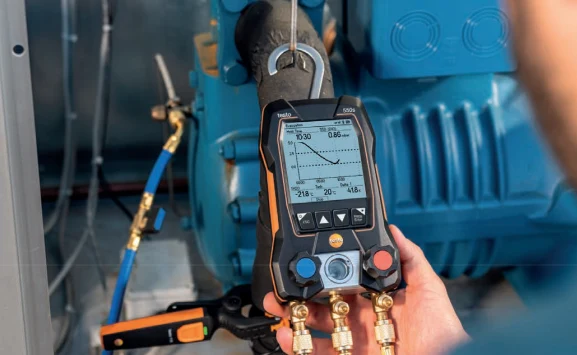
Low evaporator-side pressure does not necessarily mean a refrigerant shortage. It may be caused by a clogged metering device, a disruption in liquid-phase supply, or a heat-exchange anomaly in the evaporator. To correctly isolate the fault, a service engineer needs a set of five parameters, not a single gauge reading.
Five Parameters of Field Diagnostics
Analysis of the refrigeration circuit relies on the following values:
- Pressure on the evaporator side (low) and on the condenser side (high) — combined with the refrigerant type, these allow determination of saturation temperatures.
- Evaporator saturation temperature — calculated from the low-side pressure; characterises the state of the evaporator. A low value requires consideration of superheat, unit load, liquid-phase supply, and heat-exchange conditions before concluding that the evaporator is faulty.
- Condenser saturation temperature — calculated from the high-side pressure; assesses the efficiency of heat rejection in the condenser. A high value requires checking cooling conditions, fan operation, and cooling-water flow rate and temperature.
- Superheat (SH) — suction-line temperature minus evaporator saturation temperature; characterises the state of the refrigerant at the evaporator outlet.
- Subcooling (SC) — condenser saturation temperature minus liquid-line temperature; characterises the state of the liquid refrigerant at the condenser outlet.
What a Digital Gauge Adds Over a Mechanical One
A traditional mechanical gauge records only evaporator- and condenser-side pressure. For in-depth analysis, the engineer must separately measure pipe temperatures, consult pressure–temperature tables, and manually calculate superheat and subcooling.
A digital (electronic) refrigerant gauge combines these operations:
- automatic calculation of saturation temperatures from measured pressure;
- real-time SH and SC calculation when temperature sensors are connected;
- data storage and transfer via Bluetooth, and report generation.
In essence, a mechanical gauge measures pressure, whereas a digital gauge is a complete system: "pressure measurement + temperature measurement + automatic calculation + data archiving."
Testo 550s: Specifications and Features
The Testo 550s is positioned as a professional tool for inspection, commissioning, and acceptance of air-conditioning and heat-pump systems. Key specifications:
- dual-channel simultaneous high- and low-pressure measurement; range −1 to 60 bar; accuracy ±0.5 % of full scale; real-time display of pressure fluctuations;
- built-in refrigerant database (dozens of types); automatic saturation-temperature calculation upon refrigerant selection;
- temperature-sensor connection for real-time SH/SC calculation; pressure, saturation temperatures, pipe temperatures, and calculated values displayed on a single screen;
- Bluetooth connectivity with the testo Smart App: remote viewing, data storage, and generation of a standardised maintenance report;
- support for nitrogen leak-tightness testing with pressure and temperature curve logging;
- compatibility with the wireless vacuum sensor testo 552i for monitoring and saving the vacuum-pump-down curve.
The kit covers the full cycle: commissioning, vacuum pump-down, leak-tightness testing, and report generation. It is adapted for multi-zone systems, air-source heat pumps, cold storage, and chillers.
Practical Diagnostic Scenarios
When evaporator-side pressure is low, the combination of the remaining parameters narrows the range of possible causes:
- low pressure + elevated superheat + low subcooling — probable refrigerant shortage;
- low pressure + reduced superheat — check evaporator load and liquid-phase supply; rule out the risk of liquid return to the compressor;
- low pressure + elevated superheat + normal or elevated subcooling — check the metering device and filter-drier for blockage.
The digital gauge consolidates all parameters into a single report, eliminating the need for field reference tables and manual calculations.
Source: 制冷百科, November 5, 2026.
ORIGINAL SOURCE
制冷快报 ↗Visit the original source for additional details.