Industrial refrigeration
LG Electronics Unveils Multi V: Integrated Cooling System Up to 60 HP for Medium and Large Cold Storage Warehouses
LG Electronics has combined the outdoor unit, evaporator unit, and controller into a single Multi V system for medium and large cold chain facilities. The configuration reaches up to 60 HP with up to four evaporator units per circuit, a 5th-generation inverter compressor, and smart hot-gas defrost, enabling flexible scaling to specific warehouse requirements.
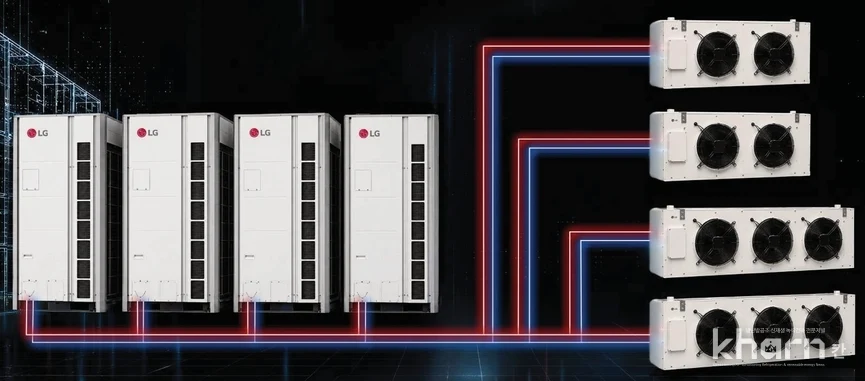
LG Electronics is launching the Multi V Refrigeration/Freezing solution for medium and large cold chain facilities, integrating the outdoor unit, evaporator unit, and controller into a single system. The refrigerant circuit configuration reaches up to 60 HP, with up to four evaporator units connected per refrigerant circuit, allowing capacity to be matched to the specific volume of a cold storage room.
System Architecture and Installation Flexibility
Outdoor units can be combined up to four units to achieve 60 HP. Refrigeration-type evaporator units are rated at up to 20 HP each, with a maximum of four per system. Instead of a multi-circuit scheme where each outdoor unit connects to a separate evaporator, Multi V uses a single-circuit piping layout, simplifying installation in medium and large cold rooms.
Key components — the core cell, stop valves for core cell service, and the oil return kit — are built into the design, reducing on-site installation work. Temperature sensors are also integrated. A single wired remote controls up to four evaporator units in group mode: unified temperature setpoint and operating mode monitoring.
For the 10 HP model (LRC-H2000F9), the following piping parameters are specified: total length up to 180 m, maximum length from the outdoor unit to the farthest evaporator — 130 m, height difference up to 35 m. This allows the outdoor unit to be placed away from the cold room in large buildings or with significant floor-level differences.
Outdoor unit 15 HP (LSC-H3000F9) dimensions: 930 × 760 × 1,745 mm, footprint approximately 0.70 m² — 48% smaller than a comparable inverter-driven model (1.36 m²). Weight is 201 kg versus 267 kg for the equivalent, reducing transport and installation load.
Compressor and Oil Management
The outdoor unit is equipped with a domestically produced 5th-generation inverter compressor with a BLDC permanent-magnet motor. The speed range of 20–150 Hz covers modes from partial to full load, delivering refrigerant volume matching actual demand.
The Smart Oil Control system monitors compressor oil level via a sensor and initiates oil return only when oil is insufficient. The HiPOR (High Pressure Oil Return) technology provides oil return through a direct path with minimal refrigerant pressure loss, maintaining the necessary compressor lubrication.
In hot weather, operation is supported by Vapor Injection for discharge temperature control and a subcooling circuit for stable delivery. Outdoor unit suction temperature range: −20 to 48 °C, accounting for radiant heating conditions, grouped outdoor unit placement, and the influence of surrounding structures.
Refrigerant supply temperature automatically adjusts to the required storage temperature. Room temperature setpoint range: refrigeration mode −5 to +20 °C, freezing mode −25 to +20 °C (the freezing evaporator supports combined mode).
Smart Hot-Gas Defrost and Temperature Stability
The Hot Gas Smart Defrost algorithm determines the evaporator's icing state using data from inlet and outlet temperature sensors, degree of superheat, operating time, and electronic expansion valve (EEV) position. When defrost is initiated, the four-way valve redirects flow: hot refrigerant from the compressor discharge is distributed across the heat exchanger, heating it evenly across its entire surface. Unlike an electric heater where heat is concentrated locally, hot gas reduces "dead zones" during defrost. When no icing is detected, defrost is not triggered, reducing temperature rise in the room and energy consumption.
In comparative tests on 2 HP models (LG Electronics' own field tests, 24 h, target room temperature 0 °C): the product with electric defrost performed 6 defrost cycles per day with temperature fluctuation of 2–3 °C; the product with Hot Gas Smart Defrost — 1 cycle with fluctuation of approximately 1 °C. A comparable inverter-driven model from a competitor was set to forced defrost of 20 min every 4 h.
In a separate test on 4 HP models (0 °C condition), the time to recover target temperature after defrost was 11 min for Hot Gas Smart Defrost versus 33 min for the electric heater.
In winter, the anti-subcooling protection function uses hot gas as an auxiliary heat source when outdoor air temperature is below the room temperature and heat loss occurs.
Four defrost modes are supported: smart, periodic, forced, and scheduled.
Minimising Electric Heating and Drain Protection
The evaporator is defrosted by hot gas, and medium-temperature refrigerant circulates through the liquid line in the drain pan, reducing the need for electric heaters. For freezing-type drain piping, an optional 24 V heater (insertion or silicone type) is provided, connected from the unit's built-in distribution panel. For refrigeration evaporator units, a 90 W auxiliary heater is applied per model.
Redundancy, Corrosion Protection, and Noise
In the event of compressor failure in a freezing model with two or more compressors, the system automatically switches to emergency mode. In a refrigeration configuration with two or more outdoor units, if one fails, backup power is supplied from the functioning unit. A rotating operating mode based on accumulated runtime is applied to distribute load across compressors.
Automatic refrigerant recovery distinguishes fault type: for indoor unit failure — Pump Down (recovery into the outdoor unit); for outdoor unit failure — Pump Out (recovery into indoor units and piping).
The outdoor unit heat exchanger uses Black Fin II: corrosion-resistant and hydrophilic coatings are applied to aluminium fins. The specification is confirmed by salt fog testing per KS D9502 and ASTM B117, with a TÜV Rheinland certificate.
For noise reduction, a low-noise inverter compressor, BLDC fan motor, and a low-noise fan design are employed.
Remote Control and Central System
The new Deluxe remote displays daily room temperature history, deviation logs, and energy consumption; on a fault or temperature deviation, an alarm screen and audible signal are activated. The remote is equipped with a Wi-Fi module for connectivity to the ThinQ platform: from a mobile device, users can set target temperature, monitor status, receive notifications for faults, deviations, and defrost events, and track energy consumption.
The ACP central controller integrates management of refrigeration/freezing systems and building engineering systems on a single screen. Connectivity: up to 32 Multi V evaporator units and up to 128 air-conditioning indoor units. Integration with temperature, humidity, and CO₂ sensors is supported; the allowable number of connectable cold chain devices depends on the sensor configuration. The screen provides per-device data, schedules, faults, and operating history; temperature and mode records can serve as an evidentiary basis for cold storage management and food safety control.
Service and Design
LG Electronics supplies the outdoor unit, evaporator units, and controller as a single package, simplifying system-level diagnostics and eliminating service inconsistencies when combining components from different manufacturers. The LGMV service diagnostic tool reads outdoor unit refrigeration cycle parameters and identifies the cause of failure; data analysis is performed by a qualified service technician.
The Hiemsoltech service division provides a 24/7 hotline (including weekends and holidays) and a network of more than 40 regional and partner service points across the country; spare parts and consumables are distributed regionally, and service personnel training is conducted in parallel.
At the design stage, LATS CAD tools and specialised applications are used; CFD calculations and acoustic analysis allow assessment of suction temperature rise under various outdoor unit placement schemes and the impact on ambient noise.
According to an LG Electronics representative, the key technologies based on the 5th-generation inverter compressor are aimed at improving reliability and efficiency in refrigeration and freezing modes, minimising losses of stored products during unexpected failures, and ensuring stable system operation.
ORIGINAL SOURCE
Kharn ↗Visit the original source for additional details.