Components & controls
GF Launches MCV Multi-Control Valve for D2C Liquid Cooling in AI Data Centers
GF has introduced the MCV multi-control valve, integrating flow regulation, five sensors, and digital communication in a single housing for D2C liquid cooling. Four models based on DN25 and DN50 cover a range from 41 to 324 kW.
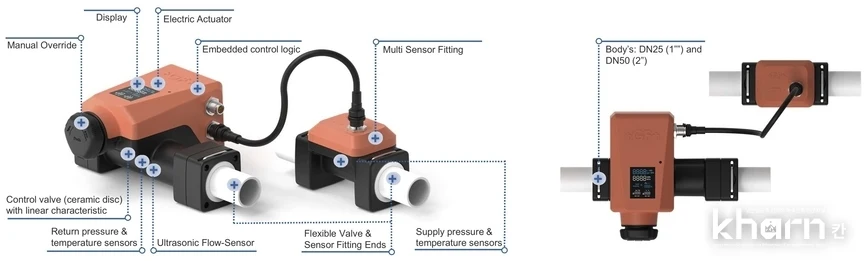
GF has presented the MCV (Multi Control Valve) for D2C liquid cooling in AI data centers. The device integrates flow regulation, temperature and pressure measurement, heat-transfer calculation, and digital communication in a single housing.
Why dynamic control is needed
In AI data centers dominated by high-density GPU servers, heat dissipation per rack exceeds 100 kW. In D2C (Direct-to-Chip) systems, multiple racks and cold plates are connected to a single coolant circulation loop: a change in pressure or flow in one section affects the cooling of the remaining racks. Dynamic Hydraulic Balancing becomes a key factor in cooling efficiency.
What the MCV does
The valve is built around a ceramic disc regulating element with an electric actuator, sensors, and embedded control logic. Unlike ball valves, the flow characteristic versus opening degree is linear, which allows precise dosing of coolant delivery to match the actual thermal load of the servers rather than maintaining a constant flow. This reduces excess pump power and improves cooling efficiency.
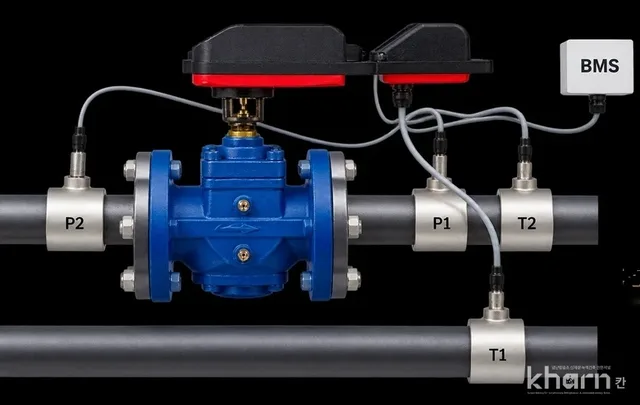
The MCV housing contains five sensors: one ultrasonic flow meter, two pressure sensors (supply and return), and two temperature sensors. The device measures flow, temperatures, and pressures at inlet and outlet, calculates ΔT, ΔP, and transferred thermal energy, and records the opening degree and valve status. The integrated differential-pressure regulation function suppresses flow unevenness in parallel branches and ensures stable delivery to each rack.
From a safety standpoint, the valve can shut off the flow in under 5 seconds; when combined with external leak detectors and a control system, it enables rapid isolation of a faulty circuit. Ingress protection rating is IP68.
Models and specifications
The MCV is available in four variants based on DN25 and DN50:
- DN50, high-performance: Kvs 51 m³/h, 324 kW at ΔP 30 kPa (300 mbar)
- DN50, standard: Kvs 36 m³/h, 230 kW at the same ΔP
- DN25, high-performance: Kvs 28 m³/h, 140 kW at ΔP 25 kPa (250 mbar)
- DN25, standard: Kvs 8 m³/h, 41 kW at the same ΔP
The range covers everything from small server loops to high-density AI circuits exceeding 300 kW. The housing is made of PPS (polyphenylene sulfide) and other high-strength engineering polymers, which reduces the risk of contaminating the coolant with metal corrosion products and preserves the long-term heat-transfer capacity of cold plates. Connections are made via PP-H fittings for welding, Tri-Clamp, or threaded joints; the design is compatible with both retrofitting existing piping and modular pre-fabricated systems.
According to GF, compared to a combination of separate metal devices, the MCV reduces occupied space by up to 50 %, mass by up to 70 %, and wiring volume in an integrated scheme by up to 60 %.
Communication and integration
The MCV supports IO-Link, BACnet MS/TP, Modbus RTU, and analog interfaces. A single IO-Link master can serve up to four MCV valves and four external leak detectors. Communication with the upper-level control system is via Modbus TCP, PROFINET, or EtherNet/IP — through a BMS or PLC. In the future, the valves can be connected to a DCIM (Data Center Infrastructure Management) system for real-time comparison of circuit operating modes and early detection of anomalies.
LiquidCore and projects in South Korea
The MCV launch strengthens GF's integrated solution "LiquidCore" — a comprehensive package of piping, valves, manifolds, and connectors for delivering coolant from the CDU to server cold plates. The lineup includes PROGEF distribution piping based on PP-H, SYGEF in-rack manifolds made of PVDF, and Quick Connect Valve 700.
In South Korea, the PVDF SYGEF manifold has been deployed on a D2C test bench for a 100 kW AI rack at the LG Uplus Pyeongchon 2 center, while at KT Cloud IDC (Seoul, Yeonsan district) technical validation of a Liquid-to-Rack distribution system based on PROGEF PP-H is underway.
GF comment
A GF representative noted that the MCV launch enables linking precise regulation at the individual rack level with overall data-center infrastructure efficiency: fast and accurate control of coolant circulation accounting for thermal load and hydraulic conditions reduces pump power losses and improves cooling stability and operational efficiency of AI data centers.
According to GF's assessment, competition in the liquid-cooling market is shifting from individual components (CDUs, cold plates) toward integrated systems that combine distribution piping, manifolds, control valves, and real-time monitoring tools.
ORIGINAL SOURCE
Kharn ↗Visit the original source for additional details.