Components & controls
Honeywell to Launch Energy Valve by Early 2027 — Pressure-Independent Solution for Flow, ΔT, and Thermal Energy Control in HVAC and Data Centers
Honeywell has announced the early-2027 market launch of Energy Valve — an integrated package combining a multi-port valve, electric actuator, sensors, and an intelligent interface for pressure-independent temperature control. The device unifies flow and thermal energy metering, coil control, and system pressure optimisation via BMS in a single circuit.
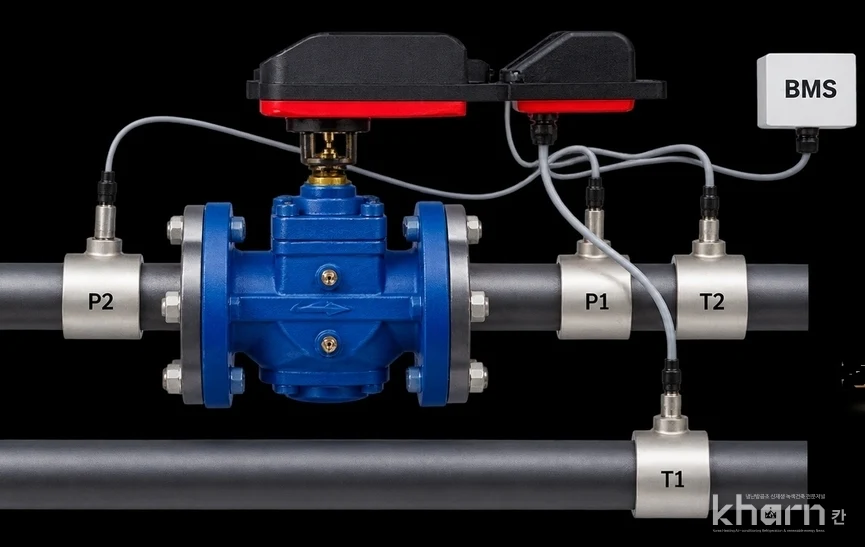
Integrated Package for Pressure-Independent Temperature Control
Honeywell (a building-solutions specialist) plans to bring the Honeywell Energy Valve to market in early 2027 — a pressure-independent solution for managing flow, temperature differential (ΔT), and thermal energy in HVAC and data-centre cooling systems. The design integrates a multi-port valve, electric actuator, temperature and pressure sensors, and an Intelligent Interface (IIF) into a single housing. The device maintains a set flow rate despite pressure fluctuations in the piping while simultaneously adjusting it in response to load changes and ΔT. Within a single circuit, flow and thermal energy measurement, coil operation control, and BMS integration are all realised.
Control Logic: Indoor-Temperature Priority, Then ΔT Optimisation
The key element is an algorithm that simultaneously accounts for room temperature and the ΔT across the coil inlet/outlet. If the room temperature deviates from the set range, priority is given to stabilising it for occupant comfort. Once the target range is reached, control switches to ΔT: flow is reduced as needed to save energy. Temperature sensors record values at the coil inlet and outlet; the IIF calculates ΔT; when the load changes or ΔT exceeds its setpoints, the valve adjusts its opening and flow accordingly. Thus, pressure-independent flow stability is combined with adaptive load-based modulation.
BMS Interaction and System Pressure Optimisation
A pressure sensor measures the differential across the valve. The BMS uses this data to optimise system pressure relative to the required differential at each valve, reducing pump energy consumption. Individual valve data is aggregated into whole-system distribution pressure management.
The IIF links all components, automatically calculates flow and thermal energy, and transmits results to a mobile device or BMS monitoring panel. Data exchange is performed over BACnet (remote monitoring and interface-module configuration) and Bluetooth (field verification via the proprietary mobile app). The app displays sensor values T1, T2, P1, P2, ΔT, pressure differential, flow, thermal energy, and target ΔT. Three control modes are provided: ΔT-based, heating/cooling-based, and "smart" control.
Technical Specifications and Applications
- Nominal bore range: DN15–DN250
- Maximum flow: up to 4,608 L/min
- Maximum working differential pressure: 800 kPa
- Working medium temperature range: −20 to +120 °C
- Actuator: standard and fail-safe (option)
- Design: compact, lightweight; supports inverted ("upside-down") installation
The Energy Valve is intended for use in standard air-handling units as well as data-centre equipment: CRAH, CDU, FWU, RDHx. On the distribution piping of each unit, the device performs flow and thermal energy measurement and implements ΔT-based control.
The product links local ΔT and flow control on an individual coil with system-level pressure management through the BMS: first the target room temperature is ensured, then flow is adjusted to the heat-exchange state, and operational data is used to optimise pumps and the distribution system.
Source: www.kharn.kr.
ORIGINAL SOURCE
Kharn ↗Visit the original source for additional details.