Industrial refrigeration
Six Commissioning Parameters for Refrigeration Systems: From Evaporation Temperature to Discharge Superheat
A practical guide to six key parameters in the commissioning and maintenance of refrigeration systems: cycle temperature boundaries, actual compressor inlet and outlet temperatures, and derived indicators of superheat and subcooling. For each parameter, approximate ranges, typical symptoms of deviations, probable causes, and corrective measures are provided.
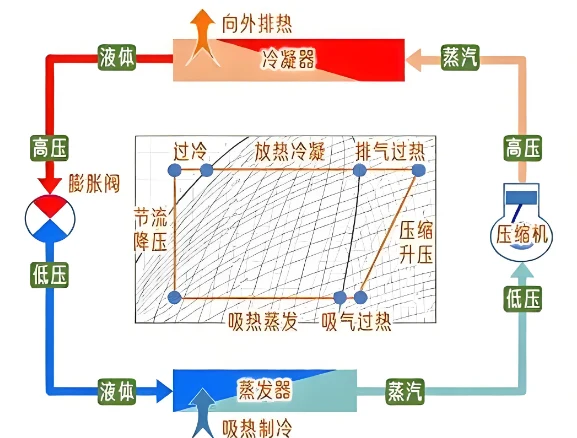
Six parameters that are essential for any commissioning or diagnostic procedure of a refrigeration system are grouped in this guide by diagnostic logic: from cycle temperature boundaries to actual compressor inlet and outlet temperatures, and further to derived indicators. The material is intended for engineers maintaining cold rooms, air-cooled and water-cooled chillers, central air conditioning systems, and industrial cooling; it is useful during commissioning, parameter assessment, fault finding, and routine inspections.
Cycle Temperature Boundaries
Evaporation temperature — the saturated boiling temperature of the refrigerant in the evaporator, corresponding to the low-side pressure. It is this parameter that determines the actual cooling capacity of the system.
Reference: for standard refrigerated rooms, the evaporation temperature is 5–10 °C below the set storage temperature; in low-temperature rooms the difference is greater, and the higher the thermal load, the wider this gap.
-
High evaporation temperature. Symptoms: slow temperature drop, low-side pressure above normal. Causes: expansion valve opened too far, thermal load exceeding design, frost or scale buildup on the evaporator, insufficient airflow. Measures: partially close the valve, remove frost, flush the evaporator, check fan speed, locate and eliminate heat leaks in the room.
-
Low evaporation temperature. Symptoms: heavy frost on the evaporator, low-side pressure below normal, noticeable drop in cooling capacity. Causes: expansion valve opened too little, insufficient refrigerant feed, partial blockage of piping or filter, refrigerant undercharge. Measures: gradually open the valve, locate the leak and top up refrigerant, flush and dry the filter-drier.
Condensation temperature — the saturated condensation temperature of the refrigerant in the condenser, corresponding to the high-side pressure. It sets the energy consumption level and the likelihood of protective trips.
Reference: for air-cooled units, the condensation temperature equals ambient temperature plus 8–12 °C; for water-cooled units — condenser outlet water temperature plus 5–8 °C.
-
High condensation temperature. Symptoms: spike in high-side pressure, increased power consumption, high-temperature protection trip, frequent shutdowns. Causes: condenser fin fouling, fan malfunction, poor room ventilation, high ambient temperature, refrigerant overcharge. Measures: wash the fins, repair the fan, improve ventilation, remove excess refrigerant.
-
Low condensation temperature. Symptoms: unstable low-side pressure, intermittent flow through the valve, insufficient capacity in low-temperature mode. Causes: excessive heat rejection, absence of fan speed control in an air-cooled unit, refrigerant undercharge. Measures: install a condenser pressure regulator, reduce excessive heat rejection, locate the leak and top up refrigerant, re-adjust the operating mode.
Actual Compressor Inlet and Outlet Temperatures
Suction temperature — the actual refrigerant temperature at the moment it enters the compressor suction port. It indicates whether liquid refrigerant is returning and how correct the suction superheat is. Basic rule: suction temperature is always higher than evaporation temperature.
-
High suction temperature. Symptoms: increased suction superheat, compressor body heating, rising discharge temperature, reduced efficiency. Causes: expansion valve opened too little, insufficient feed, refrigerant undercharge, poor heat exchange in the evaporator. Measures: gradually open the valve, top up refrigerant, flush the evaporator.
-
Low suction temperature. Symptoms: temperature close to evaporation temperature, frost on the suction line, high risk of liquid slugging and compressor damage. Causes: expansion valve opened excessively, strong liquid return, uneven refrigerant distribution. Measures: partially close the valve, check the distributor, completely remove frost.
Discharge temperature — the actual refrigerant temperature at the compressor outlet. The difference between discharge temperature and condensation temperature (discharge superheat) is the ultimate indicator of compressor superheat and operating severity.
Reference for typical units: discharge superheat 15–35 °C.
- High discharge superheat. Symptoms: abnormal compressor heating, temperature protection trip, oil carbonization, risk of compressor failure. Causes: high suction superheat, poor heat rejection, refrigerant undercharge, high compression ratio, prolonged operation under overload. Measures: re-adjust the expansion valve, top up refrigerant, clean heat exchangers, reduce the load on the unit.
Derived Parameters: Suction Superheat and Subcooling
Suction superheat (suction temperature minus evaporation temperature) — a key indicator during commissioning. It shows how «dry» the suction vapor is and serves as the main barrier against liquid slugging.
Recommended range: 5–10 °C.
-
Superheat above 12 °C. Consequences: reduced efficiency, increased power consumption, constant compressor overheating. Causes: insufficient feed, valve opened too little, refrigerant undercharge. Measures: gradually open the valve, top up refrigerant if necessary.
-
Superheat below 3 °C. Consequences: risk of liquid return and liquid slugging, impact on valve plates, reduced compressor life. Causes: valve opened excessively, low thermal load, refrigerant overcharge. Measures: partially close the valve, remove some refrigerant.
Subcooling (saturation temperature on the condensing side minus actual liquid refrigerant temperature at the condenser outlet) — an indicator of liquid-phase stability. Adequate subcooling prevents premature boiling in the liquid line and ensures smooth operation of expansion valves.
Recommended range: 3–5 °C.
-
Subcooling above normal. Symptoms: excessive heat rejection, high-side pressure below normal, unstable operating mode. Causes: overly intense condenser heat rejection, excess cooling water or air flow. Measures: reduce heat rejection, adjust fan speed or water flow, set temperature limits.
-
Subcooling below 2 °C. Symptoms: boiling in the liquid line, uneven feed, temperature fluctuations in the room, hissing and rumbling at expansion valves. Causes: poor heat exchange in the condenser, refrigerant undercharge, damaged pipe insulation. Measures: flush the condenser, top up refrigerant, restore and reinforce insulation.
Summary Reference Table
| Parameter | Approximate Range |
|---|---|
| Evaporation temperature (standard room) | 5–10 °C below storage temperature |
| Condensation temperature (air-cooled unit) | t_ambient + 8–12 °C |
| Condensation temperature (water-cooled unit) | t_water outlet + 5–8 °C |
| Suction superheat | 5–10 °C |
| Subcooling | 3–5 °C |
| Discharge superheat | 15–35 °C |
Mnemonic for Quick Recall
Evaporation — watch the temperature drop; condensation — watch the high-side pressure; Suction — protect against liquid slugging, five to ten degrees is normal; Subcooling — keep the feed stable, three to five degrees is standard; Discharge superheat rising — protect the compressor.
Source: Refrigeration Technology Encyclopedia (制冷百科), 11.11.2026
ORIGINAL SOURCE
制冷快报 ↗Visit the original source for additional details.