Chillers & heat pumps
Mitsubishi Electric's New Plate Heat Exchanger Triples Heat Transfer and Cuts Refrigerant Charge to One-Third
Mitsubishi Electric has developed a plate heat exchanger for heat pump cooling and heating equipment that achieves approximately three times the heat transfer performance of its conventional grooved-plate models. The design reduces refrigerant charge to roughly one-third, addressing safety and environmental concerns tied to flammable next-generation refrigerants.
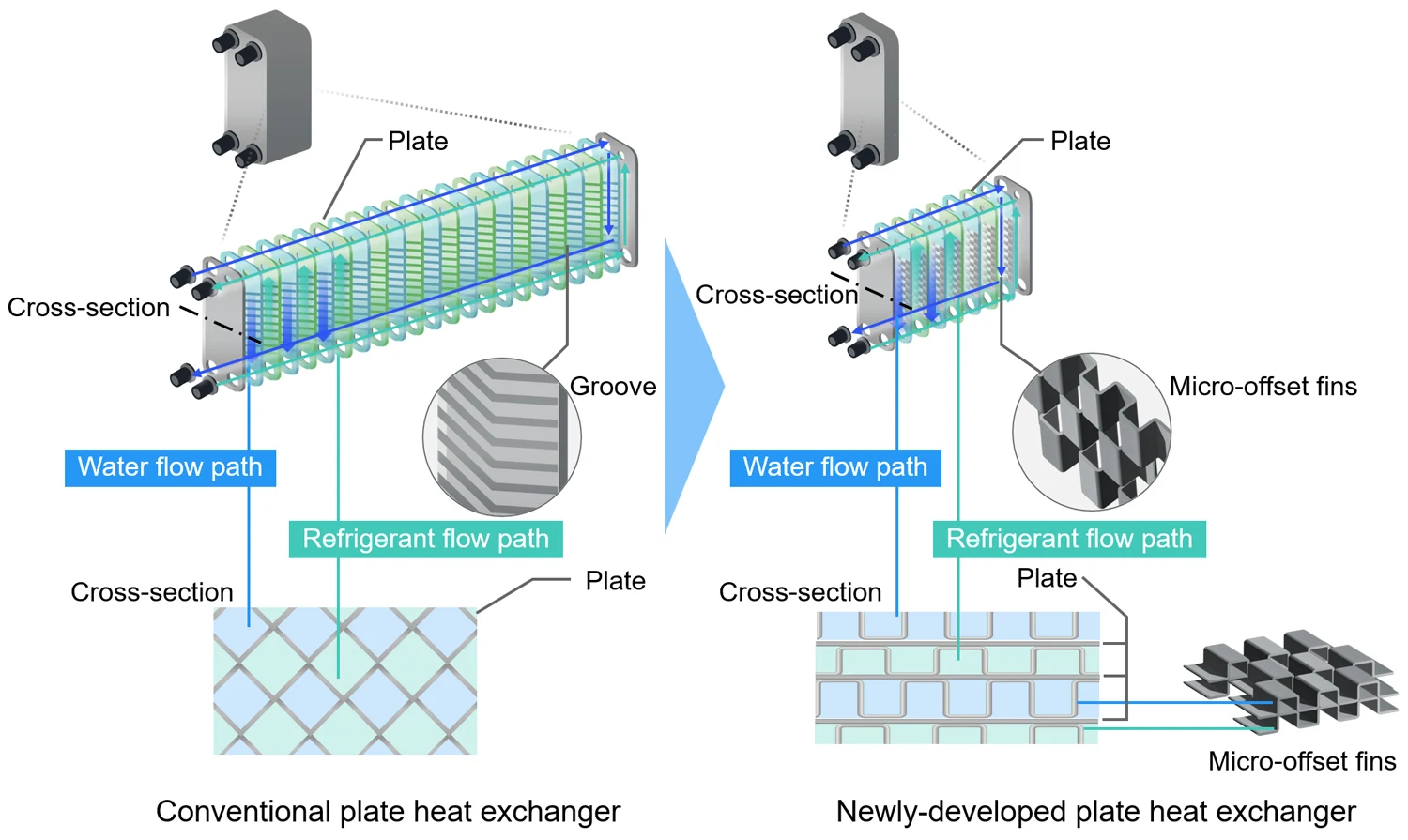
Mitsubishi Electric Corporation (TOKYO: 6503) announced on September 14, 2026, in Tokyo the development of a plate heat exchanger for heat pump cooling and heating equipment with what the company describes as industry-leading heat transfer performance – approximately three times that of its conventional grooved-plate models. The new design reduces the number of plate layers, cutting the refrigerant charge to approximately one-third of conventional levels, resulting in lower environmental impact and improved safety.
The key innovation lies in distribution channels at the fluid inlets and outlets that ensure uniform refrigerant flow across all plates, even when micro-offset fins are fitted. Micro-offset fins – fine fins arranged in an offset pattern to promote turbulence and heat transfer – had previously been considered to improve heat transfer, but testing showed that gas-liquid two-phase flow did not distribute uniformly across an entire plate. Mitsubishi Electric optimized channel placement using proprietary analysis technology that simulates the complex flow of two-phase refrigerants between fine fins, achieving an even distribution of gas-liquid two-phase flow.
The development responds to tightening refrigerant regulations driven by the push toward carbon neutrality. Next-generation refrigerants such as R32 carry a lower Global Warming Potential (GWP) than their predecessors, but many are flammable, making it essential to minimize the volume used to reduce the danger of accidental leaks. Conventional grooved-plate heat exchangers, while reducing charge through higher heat transfer, perform insufficiently in this regard.
Mitsubishi Electric states the technology can be applied to a wide range of products, including:
- water-based cooling and heating equipment
- heat pump systems for electric vehicles (EVs)
- air-cooled air conditioners
The company plans to incorporate the new heat exchanger into its diverse product lineup to contribute to global carbon-neutrality efforts.
Source: Mitsubishi Electric press release No. 3936, September 14, 2026.
ORIGINAL SOURCE
Mitsubishi Electric: News ↗Visit the original source for additional details.