Science & technology
HSE and Ural Federal University Publish Graph-Based Fault Detection Method for Data-Center Refrigeration
Researchers at HSE and Ural Federal University developed a physics-informed graph neural network for detecting refrigerant leakage and heat-exchanger fouling in data-center cooling systems. The method was validated on an experimental DATARK rig across four induced fault scenarios; validation on operating facilities remains future work.

HSE and Ural Federal University researchers have published a graph neural-network approach for early detection of refrigerant leakage and heat-exchanger fouling in data-center cooling systems. The work appeared in IEEE Transactions on Industry Applications.
Physics-informed architecture
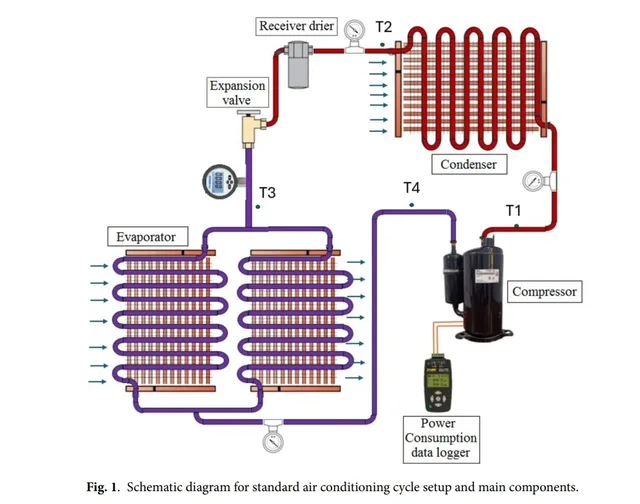
The model encodes the physical topology of the refrigeration circuit, linking individual components through their actual connections. Rather than relying on labelled fault data, it is trained exclusively on healthy-operation records and flags anomalies by comparing predicted sensor behaviour against observed values.
Experimental validation
Testing was carried out on an experimental DATARK refrigeration rig. The setup provided 12 sensor signals and four calculated variables, sampled at one-minute intervals. Four induced fault scenarios were examined, and the authors report early-detection and F1 scores for these controlled experiments.
Scope and next steps
The reported metrics reflect performance on the experimental rig under induced faults and do not constitute proven performance across operating data centres. Validation on real facilities is identified as future work.
ORIGINAL SOURCE
КриоФрост ↗Visit the original source for additional details.