Industrial refrigeration
Cooling Towers: Working Principle, Main Types, and Safety Requirements
Cooling towers reject excess heat through evaporative water cooling — a principle used in industry for over 100 years. The review covers construction and operating cycle, four main types by air delivery method, key parameters (approximately 1% evaporation per 7 °C of cooling), and Legionella protection measures, including mandatory drain eliminator replacement per UNE 100030/2017.
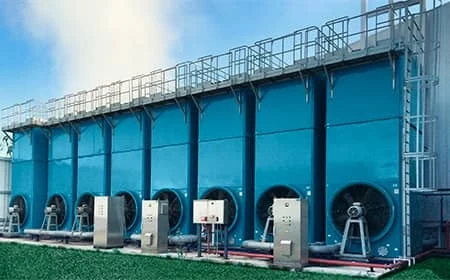
Cooling towers (water cooling towers) are equipment based on evaporative cooling: water acts as the refrigerant, and excess heat from industrial processes and heat engines is transferred to the atmosphere. This principle has been used in industry for over 100 years. It is important not to confuse evaporative cooling with adiabatic cooling.
Construction and Operating Cycle
A typical tower includes:
- a heat and mass transfer surface (fill) with a water distribution system;
- a ventilation system — natural or forced;
- auxiliary components: collection basin, recirculation pump, drain eliminators, and monitoring instruments.
Operating cycle: hot water is sprayed as a rain of droplets onto the fill — a set of thin PVC plates arranged in a specific configuration. Air enters through lower openings located above the basin and moves from bottom to top. In the fill, water (at a higher temperature) and air (at a lower temperature) meet; heat exchange is enhanced by the increased surface area and contact time. During evaporation, a portion of the water absorbs heat from the overall stream, cooling it. The cooled water is collected in the basin and fed into the circuit for air conditioning, air treatment, or industrial processes.
For every 7 °C of cooling, approximately 1% of the total water flow evaporates. The evaporated moisture passes through drain eliminators — components with losses of less than 0.002% — which prevent the release into the atmosphere of water potentially contaminated with Legionella bacteria. Per standard UNE 100030/2017, drain eliminators must be replaced every 10 years.
Tower Types by Air Delivery Method
- Natural draft. The air flow is created by a density difference between cold outside air and moist air inside the tower. Tall stacks are used. Applied at water flows exceeding 200,000 gal/min (gpm), typical for thermal power plants.
- Induced draft. Air is drawn in by a fan installed at the top of the tower. The most common and efficient type.
- Forced draft. The fan is located at the bottom and blows air that exits from the top. Less efficient due to lower exhaust velocity.
- Cross-flow. Air enters from the side and moves horizontally through the falling water. Requires a larger air volume but has lower operating costs compared to counter-flow towers.
Safety and Legionella
Evaporative coolers can become a medium for the proliferation of Legionella pneumophila only when several conditions coincide simultaneously: the presence of a contaminated culture in the system, uncontrolled operating conditions, the release of contaminated droplets into the atmosphere, and the inhalation of a sufficient quantity of microdroplets. If the incoming water is not contaminated and the equipment is maintained in accordance with the law (Royal Decree 865/2003, which prescribes two inspections and cleanings per year), the risk is minimal.
Advantages Over Refrigerant-Based Systems
Compared to installations using refrigerants, cooling towers provide: a higher energy-saving effect, lower capital costs compared to air-cooled condensers, a smaller environmental impact, and a lower noise level. ANEFRYC Secretary-General Manuel Lamua elaborates on these advantages in a separate publication.
Torraval
Torraval Cooling offers a full range of services: design, manufacturing, installation, maintenance, upgrade, and retrofit of cooling towers.
Sources: ATEYCR, AEFYT. Article updated November 25, 2024.
ORIGINAL SOURCE
Caloryfrio ↗Visit the original source for additional details.