Chillers & heat pumps
16 Types of Refrigeration and Climate Machines: From Scroll Chillers to CO₂ Pumps
An overview of 16 types of refrigeration and climate equipment: compressor chillers (scroll, screw, centrifugal, magnetic-bearing, and gas-bearing), absorption machines, heat pumps (air-source, geothermal, water-source, CO₂-critical), and specialized solutions. For each type, the operating principle, cooling capacity range, and typical applications are outlined.
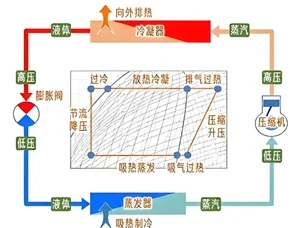
The refrigeration and climate industry's arsenal comprises 16 main types of machines — from scroll compressors for low cooling capacities to CO₂ pumps delivering heat transfer fluid above 80 °C. The choice of type is determined by cooling capacity, energy source, temperature range, and operating conditions.
Compressor Chillers
Scroll chillers are equipped with a scroll compressor and are used in low- to medium-capacity applications. Two scroll disks (one stationary, one rotating) perform eccentric rotation, forming a continuously changing compression chamber; the compression process is smooth, and pressure pulsations are minimal.
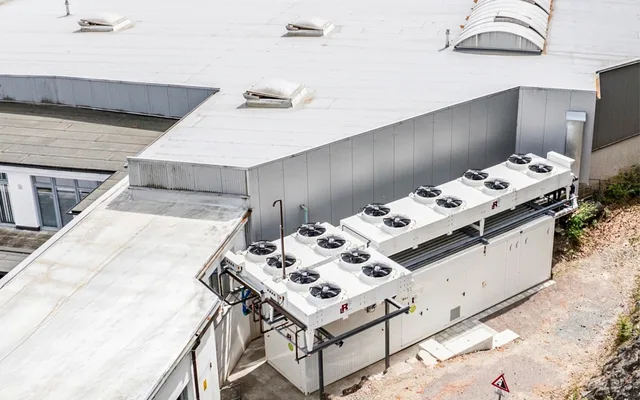
Screw chillers are the primary machines in the medium- to large-capacity segment for commercial buildings. They come in single-screw and twin-screw configurations: a pair of gears (male and female rotors) rotate in mesh, continuously performing suction, compression, and discharge. Cooling capacity covers a range of 100–2,000 tons, with load adjustable steplessly from 10–100%. Excellent part-load efficiency, stable operation, long service life, and no surge at low loads. Typical applications include shopping malls, hotels, and office buildings.
Centrifugal chillers are designed for ultra-large cooling capacities. Compression is achieved by a high-speed impeller using centrifugal force; a multi-stage sequential impeller arrangement allows a higher pressure ratio to be achieved. Maximum cooling capacity of a single machine is up to 6,000 tons; in the best models, COP exceeds 6.5. Drawbacks: a noticeable drop in efficiency at low loads and a tendency toward surge. Primary applications include large complexes, data centers, and major industrial sites.
Reciprocating (piston) chillers are traditional machines with a crank-and-connecting-rod mechanism. They have a high vibration level, large footprint, and limited load-adjustment capability. They are virtually not used in new projects; they are primarily employed when retrofitting outdated systems.
Magnetic-bearing oil-free centrifugal chillers represent a new generation of centrifugal machines. Magnetic levitation bearings eliminate the oil system and oil contamination of heat exchangers. A two-stage variable-speed rotor provides high part-load efficiency, an extended surge boundary, low noise levels, and minimal maintenance. Limitations: complex electronic control system, higher cost, and stringent requirements for power supply stability. Applications include data centers, medical facilities, and premium commercial properties.
Gas-bearing (air-bearing) centrifugal chillers also belong to the oil-free centrifugal machine category. The rotating shaft is supported by a gas film formed under refrigerant pressure; the complex electronics of magnetic levitation are not required. Enhanced resistance to electromagnetic interference and excellent part-load performance. Preferred for industrial machine rooms with strong electromagnetic fields.
Absorption Machines
Lithium-bromide absorption chillers contain no compressor and are driven by heat. Water serves as the refrigerant, and a lithium bromide solution as the absorbent. The cycle is realized through a generator, condenser, evaporator, and absorber. Steam, hot water, gas, or industrial waste heat can be used as the heat source; these machines are in demand at facilities with access to low-grade thermal energy.
Ammonia-water absorption machines represent an alternative route to absorption cooling: ammonia is the refrigerant, water is the absorbent. Sub-zero temperatures are achievable. Primary sectors include the chemical industry and cold storage; they are virtually not used in comfort air-conditioning systems. Strict requirements are imposed on system integrity, ventilation, and explosion safety.
Heat Pumps
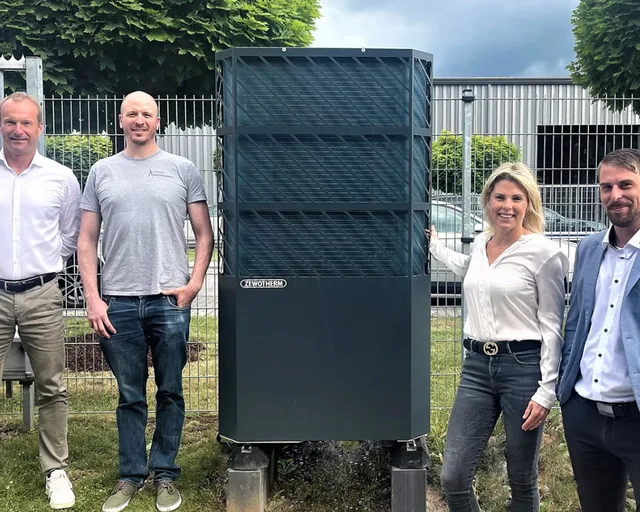
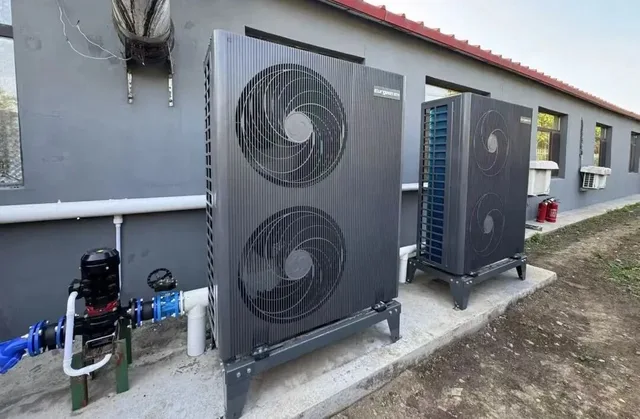
Air-source heat pumps are the most common type. Outdoor air serves as the heat/cooling source. In cooling mode, heat is removed from the space and rejected outdoors; in heating mode, low-grade heat is extracted from the air. Under severe frost conditions, heating output decreases, so electric backup heating is typically provided. Widely used in residential and small commercial segments.
Geothermal heat pumps use the constant-temperature ground (15–20 °C year-round) as the source. Heat exchange is carried out through vertical boreholes or horizontal pipe loops. In summer, heat from the building is rejected into the ground; in winter, it is extracted for heating. Stable efficiency throughout the year, provided the site allows drilling and pipe installation.
Water-source heat pumps use groundwater, surface water bodies, or wastewater. Water temperature fluctuations are significantly smaller than those of air. In summer, excess heat is discharged into the water body; in winter, heat is extracted from it for heating. Three subtypes are distinguished: groundwater, surface water, and wastewater. Suitable for facilities located near a stable water source.
CO₂-critical heat pumps operate on the natural refrigerant CO₂. They are capable of generating hot water at temperatures above 80 °C; under low outdoor temperatures, the drop in heating output is significantly less than that of conventional air-source pumps. Applications include district heating, hot water preparation, and industrial heat sources. The system operating pressure is high — piping and valves require special selection.
Specialized Solutions
Direct multi-split systems (VRV/VRF) are refrigerant-based central air conditioners in which one outdoor unit is connected via refrigerant piping to multiple indoor units. Heat exchange occurs directly with the refrigerant, without an intermediate water circuit. A variable-speed compressor controls refrigerant flow, distributing cooling capacity across zones according to load; flexible zoning.
Direct evaporative cooling chillers use the latent heat of water evaporation for cooling; energy consumption is minimal. Efficiency is highest in dry climates; at high humidity, cooling output drops noticeably. In China, they are predominantly used in projects in the northwestern region.
Ice-storage chillers (dual-mode) operate in two modes: during off-peak hours at the lowest tariff, they produce ice; during the day, the ice melts and releases cooling. This shifts the load from peak to off-peak hours. Widely used in district energy stations and large shopping malls.
Heat generators (boilers) are specialized heat sources that produce hot water or steam by burning fuel or using electricity. Gas boilers are clean and efficient, and are currently the most widely used. Coal-fired boilers have low operating costs but significant emissions; in urban areas they are being gradually phased out. Electric boilers are simple to install but have high electricity operating costs; they are often used in conjunction with peak-valley tariffs.
Source: Refrigeration Encyclopedia (制冷百科), 10.11.2026.
ORIGINAL SOURCE
制冷快报 ↗Visit the original source for additional details.