Industrial refrigeration
Evaporative Condensators: Working Principle and Selection Criteria for Industrial Refrigeration Systems
An evaporative condensator uses water evaporation to lower the condensation temperature in industrial refrigeration circuits, reducing energy consumption by more than 10% compared to air-cooled systems. The article covers the working principle, performance factors, and key criteria for selecting this equipment.
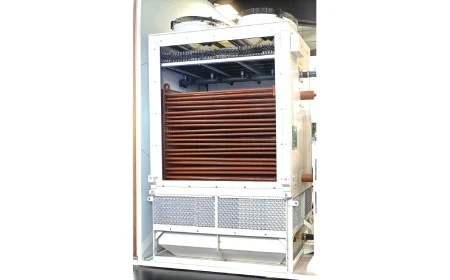
Evaporative Condensators: Working Principle and Selection Criteria
An evaporative condensator is a piece of refrigeration equipment designed for industrial cooling and industrial processes, where the condensation temperature is the primary regulated parameter of the system, directly affecting the energy efficiency of the refrigeration circuit components.
Working Principle
The design of an evaporative condensator is based on the same principle as cooling towers: heat exchange occurs between the cooled heat-transfer medium and the external environment. In cooling towers, heat exchange takes place on the contact surface — the so-called "packing" (fill media) — whereas in evaporative condensators, heat exchange occurs through a tube bundle through which the condensing refrigerant circulates.
The condensation process proceeds as follows:
- The refrigerant enters the upper header of the coil.
- The outer surface of the coil is continuously sprayed with water from the equipment's own closed recirculation system.
- A counter-flow of air is generated by the top-mounted fans.
- Evaporation of part of the recirculating water removes heat from the coil's heat-exchange surface, initiating the condensation process.
Equipment performance is determined by external temperature conditions, in particular the wet-bulb temperature. The lower the relative humidity of the outside air, the higher the efficiency: the air must absorb water vapour to provide cooling.
Selection Criteria
When selecting an evaporative condensator, several factors must be considered:
- Water supply. As water evaporates, its chemical composition and properties change, so the water must be analysed and the appropriate treatment selected for the condensator materials to prevent scale deposits that reduce performance.
- Materials. Corrosion-resistant materials reduce maintenance costs and prevent deposit formation.
- Maintenance. The design should be lightweight and easy to disassemble. The most advanced models feature fully removable walls, providing complete access to the internal space for inspection, maintenance, cleaning, and repair.
- Collection tray. It must be fully sealed, have a slope for complete drainage, and rounded corners for optimal cleaning.
Applications
Evaporative condensators serving refrigeration plants are used in:
- commercial and industrial air-conditioning systems;
- industrial logistics;
- cold storage warehouses (including food storage);
- industrial refrigeration equipment.
Advantages
- Energy efficiency: lower condensation temperatures compared to air-cooled systems allow compressor power to be reduced and energy consumption to be cut by more than 10%.
- Reduced operating costs.
- Environmental friendliness of the technology.
- With proper maintenance, hygienic and sanitary risks are minimised.
Torraval
Torraval designs, manufactures, and installs equipment for evaporative and adiabatic cooling. The company's catalogue includes evaporative chillers, evaporative condensators, and hybrid chillers.
Source: Caloryfrio, updated 25 November 2024.
ORIGINAL SOURCE
Caloryfrio ↗Visit the original source for additional details.