Standards & safety
K-HVAC and Eurovent Sign Agreement Designating Test Laboratory for International HVAC Certifications
On November 12, K-HVAC and Eurovent signed a memorandum designating a test laboratory, enabling Korean manufacturers to undergo international HVAC certification testing domestically. The seminar also presented Eurovent certification programs for heat pumps, IT cooling, hygienic AHUs, and desert climate conditions.
Test Laboratory Designation Agreement
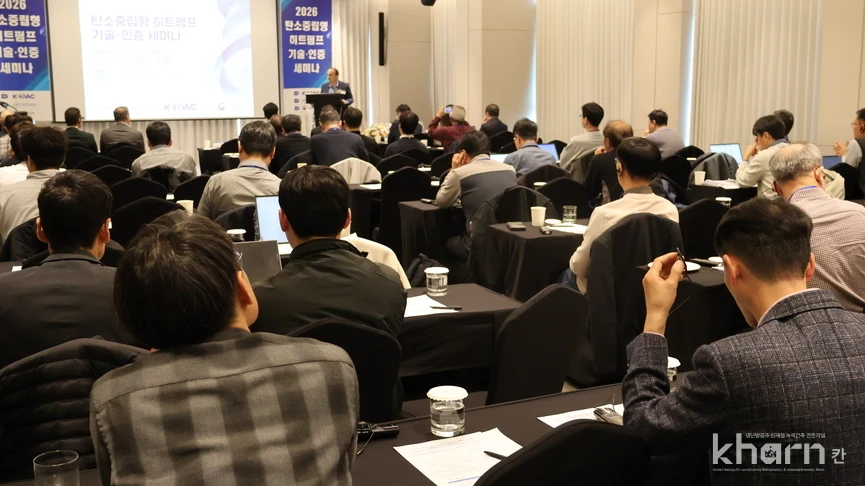
On November 12, the Korea Institute of Refrigeration and Air-Conditioning Technology (K-HVAC, Director Jeong Du-sik) held a seminar on carbon-neutral heat pump technologies and certification. As part of the event, K-HVAC and Eurovent signed a memorandum on the designation of a test laboratory. The signatories were Jeong Du-sik (K-HVAC Director) and Sylvain Courte (Eurovent Chairman).
The agreement links K-HVAC's testing capabilities with Eurovent's certification system and establishes a foundation for cooperation in international certification testing. The parties plan to support Korean companies in obtaining international certifications and to strengthen competencies in heat pump testing and certification. In particular, the test infrastructure developed under the L150 project will be utilized for product performance evaluation and support of international certifications.
K-HVAC Chairman Kim Chang-gyu noted that previously Korean companies had to ship products abroad to obtain European certification, which required significant time and cost. Now, companies will be able to undergo testing to international standards at the nearest laboratory. Kim Chang-gyu emphasized that the agreement is particularly important for small and medium enterprises without experience in dealing with foreign certification requirements, and stated the intention to expand cooperation to data center cooling and air conditioners.
Sylvain Courte, Eurovent Chairman, stated that the reliability of Eurovent certification rests on technical competence, independence, strictness of testing, and mutual trust. In his words, the agreement is not merely a recognition of K-HVAC's technical capabilities but the beginning of closer cooperation between the two institutions. Courte noted that Korea has an innovative HVAC industry and significant manufacturers for the international market, and that the common goal of both parties is to increase confidence in product performance and provide manufacturers with independent and reliable certification. He expressed hope that the cooperation would extend beyond VRF systems to other areas.
Eurovent Certification Programs
Eurovent is a non-profit industry organization founded in 1958 to unify European HVAC markets and develop common market standards. Its headquarters is in France; the organization has over 30 years of certification experience. Currently, its geographic scope covers Europe, the Middle East, India, Asia and the Pacific region, China, and Australia.
Heat Pumps
In the heat pump sector, Eurovent supports not only its own certification but also national/regional schemes: MCS (United Kingdom), NF (France), HP Keymark (EU). Certification objects include residential and commercial heat pumps: for space heating, combined (heating/cooling), for pools, for domestic hot water, combined (heating + DHW). Various heat source types and some gas models are included; industrial heat pumps are covered by a separate program.
The procedure consists of four stages: document review → sample testing → production audit → certification decision. Timelines: document review — approximately 2–4 weeks; sample testing — from 2 to 12 months; production audit — up to 2 weeks. Testing timelines depend on laboratory workload and scheduling; the certification decision is made relatively quickly when a complete document package is available. After obtaining a certificate, a system of regular testing and audits is in effect to maintain status.
Heat pump performance testing is conducted jointly with independent laboratories: CEIS (Spain), CETIAT (France), HLK (Germany), WPZ (Switzerland). Eurovent is also working on engaging additional test laboratories in response to growing demand for heat pumps in Europe.
To efficiently pass multiple certification schemes simultaneously, Eurovent offers an integrated track: one application, one document package, one sample selection — and parallel processing of multiple procedures. Duplicate testing is minimized, production audits are consolidated, reducing the time and cost of obtaining certificates.
In addition to issuing certificates, Eurovent supports the promotion of certified products through industry events, conferences, publications, and social media, and participates in client events as an independent third party.
IT Cooling (Data Centers)
To expand manufacturer participation in IT cooling equipment certification, Eurovent introduced a remote initial audit, flexible timelines for software certification preparation, and cost optimization. It is not necessary to certify the entire product line: the manufacturer selects product groups based on market demand and competitiveness. Annual limits: up to 4 units for testing, 1 facility for audit.
The program has approximately 750 units and 2 verified production facilities registered. European EN standards are applied; compatibility with the future EU Lot 21 regulation is considered.
Certification objects: computer room air conditioners (CRAC), computer room air handlers (CRAH), water-based in-row cooling systems. Products for 50 Hz and 60 Hz networks, various airflow directions, and fan configurations are included. Coolant distribution units (CDU) are planned for inclusion in the program in the future; Fan Wall is certified through the existing AHU program.
Testing is conducted in independent laboratories: TÜV NORD (Germany), Spanish laboratories. For large equipment that is difficult to test in an independent laboratory, partner laboratory IMQ (Italy) is used: the manufacturer can conduct testing at its own facilities under partner supervision.
Certification is conducted by product groups; all models within a group must be declared. Key requirements: annual performance testing, selection software certification, production audit, accreditation of participating laboratories. For initial certification, testing and audit must be completed; in case of non-conformity — corrective actions. If selection software is already in operation, preparation for certification audit is required; if it is not available, certification is possible after the first certificate is issued.
Key evaluation parameters: cooling capacity, power consumption, energy efficiency, sensible heat ratio, airflow, hydraulic losses, sound power level. Testing is conducted both under standard rated conditions and under non-standard conditions selected randomly within the actual operating range. Selection software certification is mandatory: within the declared range, the accuracy of calculated data is verified. If tolerances are exceeded, the manufacturer is required to correct declared characteristics, catalogs, and software. Test samples (1–4 units) are selected by Eurovent, not the manufacturer.
When using own test facilities, the partner accredited laboratory assesses their competencies, then an independent laboratory conducts regular verification tests and compares results with manufacturer data.
For the Middle East market, a "Desert Certification" option has been introduced: testing at outdoor temperatures of 35 °C (T1) and 46 °C (T3), as well as a functionality test at 52 °C. For water systems, a separate supply temperature parameter is provided. The option is linked to Middle East certification systems, including SASO (Saudi Arabia): upon meeting minimum energy efficiency requirements, products receive recognition in the local market.
Hygienic AHU
Alexander Stuber, Eurovent Director for the Asia-Pacific region, presented the certification program for hygienic air handling units (Hygienic AHU). The program was developed based on standards DIN 1946-4, VDI 6022-1, ASHRAE 170, EN 15780, and specifies requirements for the design, operation, and maintenance of hygienic equipment.
Certification is divided into three levels: 1 star — general civil buildings (hotels, offices, schools, commercial facilities); 2 stars — facilities with elevated hygienic requirements (hospitals); 3 stars — clean rooms, pharmaceutical production.
The program complements existing AHU performance certification: model box testing, actual product testing, production audit, selection software verification. Additionally assessed: material quality, corrosion resistance, leak probability, accessibility of internal components for service and cleaning, adequacy of documentation (IOM, etc.).
An energy label for AHU comparison is provided: the assessment accounts for seasonal operating conditions and meteorological data, allowing comparison of efficiency, CAPEX, and OPEX across different manufacturers. Detailed requirements and procedures are set out in the document "ECP-05 AHU Appendix H" on the Eurovent website.
Desert Climate Certification
Marcus Lattner, Eurovent Director for International Affairs, presented the Desert Certification program. In the Middle East region, summer outdoor temperatures reach 46–48 °C, and in some areas — 52 °C; significant humidity differences exist between coastal and continental zones. Standard testing at T1 (35 °C) does not reflect actual conditions.
The program adds testing at T3 (46 °C) to the existing Eurovent certification; for certain countries (e.g., Kuwait), T4 is optionally provided. A functionality test at 52 °C for 2 hours is conducted. Current objects: chillers, VRF systems, air conditioners, IT cooling equipment, rooftop AHUs. In the future — cold chain equipment.
An optional seasonal energy efficiency assessment is provided: calculation per EN 14825 for desert climate and seasonal coefficient of performance per ISO 16358.
Procedure: document submission and review (1–2 weeks) → Eurovent sample selection and testing (~3 months) → selection software verification. Total duration — approximately 4–5 months. For visual distinction, a red certification label has been introduced (as opposed to the green one for standard Eurovent certification).
Eurovent has received SASO recognition as a conformity assessment body: upon meeting Saudi Arabia's minimum energy efficiency requirements, certified products can avoid a duplicate conformity assessment procedure.
The program is positioned as an option to existing certification, avoiding the creation of a separate system and minimizing additional costs. Eurovent intends to extend Desert Certification to markets with similar climates: India, Vietnam, Malaysia.
Eurovent International Strategy
Marcus Lattner characterized the activities of Eurovent International. In addition to being an industry association, Eurovent performs certification and analytics functions: Eurovent Market Intelligence collects and analyzes statistics and market information on HVAC in Europe and adjacent regions; plans include expansion to the Middle East and Asia.
Key industry challenges include: transition to new refrigerants, growing electricity consumption, tightening of minimum energy performance standards (MEPS), life cycle assessment, circular economy, expanding environmental regulations, as well as trade conflicts and tariff barriers, increasing the need for diversification of production sites and supply chains.
Key directions of Eurovent International: strengthening interregional cooperation, MEPS harmonization, reducing trade and technical barriers, responding to environmental regulations, expanding third-party performance certification. Priority — reducing duplicate testing and creating a universally recognized regulatory framework.
In the Asia-Pacific region, the focus is on growing demand for certified products and incorporating regional technical issues into international standards; local industry opinions are conveyed to Eurovent technical committees. In the Middle East — work on refrigerant transition, MEPS tightening, specialist qualification; harmonization of regulations in the UAE, Bahrain, and Saudi Arabia. In particular, at the initiative of SASO, technical requirements based on international standards are being developed for commercial refrigeration equipment (display cases, beverage coolers).
In India, work is underway with the Bureau of Energy Efficiency (BEE) to develop common testing standards and performance evaluation criteria for VRF systems, to eliminate discrepancies in declared characteristics between manufacturers.
On October 19, 2027, the "HVACR Next Generation" event will take place in Riyadh (Saudi Arabia). A quarterly analytical bulletin "Eurovent International Insights" is published with an overview of key political and technological trends in the global HVAC industry.
Organizational Information
The seminar was organized by K-HVAC, conducted with the support of the Korea Institute of Industrial Technology Promotion (KIPA), and backed by the Ministry of Trade, Industry and Energy of Korea. Participants included: Sylvain Courte (Eurovent Chairman), Marcus Lattner (Eurovent Director), Alexander Stuber (Eurovent Director for Asia-Pacific), Emiliano Calvanese (Eurovent General Director for Marketing and Development), Son Sok (Head of Innovation Base Department, KIPA), Jeong Du-sik (K-HVAC Director), Kim Chang-gyu (K-HVAC Chairman).
ORIGINAL SOURCE
Kharn ↗Visit the original source for additional details.