Chillers & heat pumps
Carbon Neutrality in AI Data Centers: From Cooling Efficiency to Energy Management
At the KDCC seminar (November 10), experts outlined the expansion of data center carbon neutrality strategy beyond equipment efficiency: service-level emissions accounting via digital twin, the shift to liquid cooling in AI data centers, and direct PPA contracts for renewable energy.
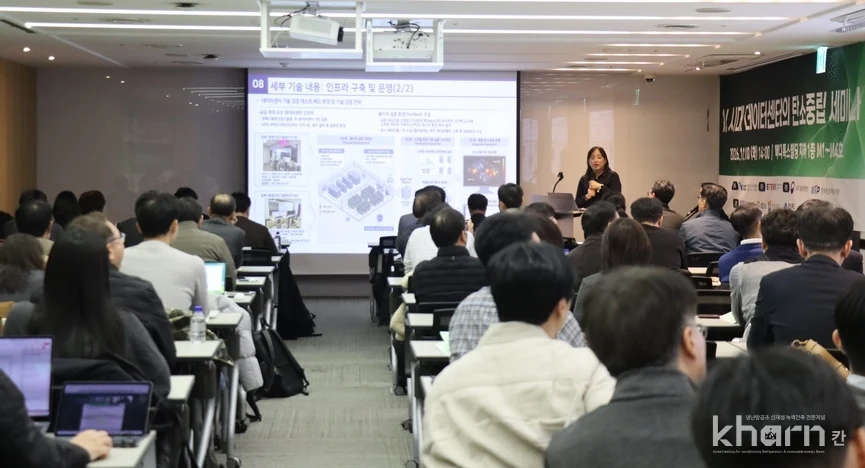
The carbon neutrality strategy for data centers extends beyond improving cooling efficiency to encompass energy supply, load management, and renewable energy procurement. This was highlighted at the seminar "Carbon Neutrality of Data Centers in the AI Era," held on November 10 by the Korea Data Center Council (KDCC). The event was organized by KDCC, conducted with the support of the Electronics and Telecommunications Research Institute (ETRI), and backed by the Ministry of Science, ICT and Communications (MSIT) and the Information and Communication Technology Planning and Evaluation Agency (IITP).
Service-Level Emissions Accounting: ETRI Project
A key technical direction is the ETRI project "Development of Architecture and Technology for Comprehensive Operation of Carbon-Oriented Digital Service Infrastructure," scheduled for April 2026 through December 2029. The lead organization is ETRI, with Onion Software and other partners participating.
According to ETRI project lead Gu Tae-yeon, emissions were previously assessed based on total data center consumption, whereas the new objective is to determine each individual service's contribution to the carbon footprint. Four core modules are being developed: emissions and carbon footprint calculation, digital twin generation with real-time 3D visualization, high-speed thermal and energy simulation, and hybrid CFD-PINN forecasting. An intelligent real-time decision-making system tracks thermal "hot spots" during equipment redistribution and uses generative AI to evaluate various operational scenarios.
The target accuracy for calculating the carbon contribution of an individual service based on the digital twin is at least 95%. In infrastructure design, a simulation technology is being developed to model expected emissions under various scenarios in advance and propose optimal redistribution of servers and workloads.
The system will be piloted in two zones: the CPU zone of the Gyeongbuk Cloud data center (consumption of approximately 20 kW, 2,100 cores, multi-tenant web hosting and general-purpose services) and the GPU zone of the Ultra-AI Cloud Farm (112 active GPUs, high-density configuration for training and inference). Smart PDU meters are used for data collection on consumption and verification of calculations.
The presentation also outlined expected effects: a 5% annual improvement in PUE, a 2–3 year investment payback period, annual energy cost savings in the range of several hundred million won, and improved carbon management levels in small and medium data centers.
Policy Landscape: From Equipment to the Energy System
Jang Hyeon-seok (Korea Trade Association) emphasized that data center carbon neutrality is not only a technological but also a systemic challenge, covering generation, transmission, and operation. The strategy is shifting from improving the efficiency of individual cooling systems to optimizing the carbon footprint at the level of the entire energy supply.
Approaches in major countries differ:
- The EU relies on the Energy Efficiency Directive (EED), strengthening reporting on data center energy efficiency and sustainability.
- The US focuses on accelerated expansion of transmission networks, reducing interconnection queues, large PPA contracts with private companies, and nuclear energy, including small modular reactors (SMR).
- Singapore accounts for electricity and water constraints, allocating new capacity in favor of the most efficient operators.
- Japan promotes regional distribution of data centers and integration with energy infrastructure.
The common principle is to consider measurable efficiency and carbon metrics before making investment and siting decisions.
South Korea faces structural constraints: as of 2025, 74.8% of private data centers are concentrated in the metropolitan region. Of 154 grid interconnection applications filed between 2021 and 2025, supply was secured in only 88 cases (57.1%). According to the Korea Energy Economics Institute, data center consumption in 2023 was approximately 5.0 TWh (≈0.9% of total consumption), and by 2030 peak demand could reach 3.3 GW. Jang Hyeon-seok called for building a system of measurable energy consumption and emissions indicators capable of driving market change, rather than simply setting reduction targets.
AI Data Centers: Liquid Cooling and Integrated Projects
Yoo Nam-son (Samwoo Architects) noted that the transition from cloud data centers to high-density AI data centers requires a rethinking of building architecture, cooling systems, and power supply. Air cooling can no longer handle the heat output, so the share of liquid cooling (DLC — Direct Liquid Cooling) is growing: heat from chips is removed via cold plates and transferred to the building loop through a CDU (Coolant Distribution Unit).
Changing the cooling type affects data hall layout and engineering systems: the hall area may decrease, but heat generators, cooling systems, UPS units, and other infrastructure elements require separate calculation. To improve energy efficiency, pre-cooling (use of outdoor cold air) is applied, reducing the load on chillers, while liquid cooling allows the use of a higher-temperature coolant, expanding the pre-cooling range. When using cooling towers and chillers, regional water consumption constraints must be considered.
Among the tasks is waste heat recovery (heating, snow melting), but economic viability is determined by the cost of piping, heat exchangers, and operation. Yoo Nam-son also pointed to the need for institutional support to offset the high capital costs of environmentally friendly equipment.
RE100 and Direct PPA: Energy Supply as a Competitive Advantage
Kwon Jae-won (Ajou University) emphasized that the key parameters for AI data center energy supply are available capacity (MW), interconnection timelines, and energy cost over a 20-year horizon. Expansion of GPU clusters and deployment of ultra-dense racks create peak loads that, when GPU tasks are synchronized, can lead to increased conductor losses and electrical equipment overloading.
According to the climate group (as of June 2025), 469 companies worldwide are part of the RE100 initiative: US — 101, Japan — 93, UK — 51, South Korea — 36.
In South Korea, regional disparity persists: 80.6% of data center power supply applications are in the metropolitan region, yet timely supply is possible in only 11.6% of cases. Meanwhile, in the Honam provinces and on the east coast, generation exceeds demand or capacity is curtailed. Introducing regional tariff differentiation could create a difference of approximately 10 won/kWh between regions. The industrial tariff in South Korea rose from 105.5 won/kWh in 2021 to 187.6 won/kWh in January 2025.
As a tool for renewable energy procurement, a direct PPA (Power Purchase Agreement) is being considered: a contract between a generator and a renewable energy operator, and between the operator and the end consumer. The KPX (Korea Power Exchange) platform provides registration, settlement, and counterparty matching. Kwon Jae-won noted that with current tariff growth, KEB (Korea Electric Power Corporation) self-generation or operational leasing becomes competitive, and in some cases on-site PPA allows obtaining energy below the KEB tariff.
From 2027, new renewable energy projects in South Korea will be allocated through government competitive bidding and long-term contracts; existing REC equipment and contracts will be phased in under transitional provisions through the end of 2029. Kwon Jae-won noted that AI data center operators need to simultaneously consider government auction volumes and prices, terms for converting existing REC contracts, and opportunities for new private PPA. As an alternative scenario, siting AI data centers in distributed energy zones (e.g., Henam Solar City) with a direct PPA link was proposed.
Kwon Jae-won concluded that the competitiveness of an AI data center is determined not by construction speed and cost, but by the ability to reliably and economically secure energy and effectively manage loads.
Source: KHARN
ORIGINAL SOURCE
Kharn ↗Visit the original source for additional details.