Chillers & heat pumps
Heat Pumps: Working Principle, Classification, and Regulatory Restrictions by 2026
Heat pumps are consolidating as the central technology for building electrification and decarbonization. From 1 January 2026, EU Regulation 2024/573 restricts the use of fluorinated refrigerants with GWP ≥ 2500 for servicing and maintenance of such equipment. AFEC President Francisco Perucho emphasizes that overall efficiency is determined not by the characteristics of a single unit but by the design of the entire installation, building loads, and installation quality.
Technology and Working Principle
A heat pump is a thermal machine that uses a refrigeration circuit to transfer heat between two sources at different temperatures. It requires energy, typically electrical, to drive primarily the compressor. The principle is analogous to a domestic refrigerator: heat is extracted from one source and transferred to another, but in a climate application the cycle can be reversible — in winter, heat is delivered into the building; in summer, it is extracted from the building and rejected outdoors.
In a closed circuit, four stages occur sequentially:
- Evaporation. The refrigerant at low pressure and low temperature circulates through the evaporator, absorbing thermal energy from the external source (air, water, or ground) and transitioning to a gaseous state.
- Compression. The gaseous refrigerant enters the compressor; as pressure increases, so does temperature.
- Condensation. The heated refrigerant passes through the condenser, releasing energy to the medium that needs to be heated (air or water), and condenses.
- Expansion. Through the expansion valve, pressure and temperature drop sharply; the refrigerant returns to a state suitable for the next cycle.
In a reversible pump, a reversing valve changes the direction of the refrigeration cycle, enabling cooling mode.
Classification and Applications
Classification is based on the energy extraction source and the distribution medium. Aérothermie is not a separate equipment type but an indication of the source (air); the thermodynamic cycle remains unchanged.
| Type | Source | Distribution Medium | Typical Applications |
|---|---|---|---|
| Air-to-air | Outdoor air | Indoor air | Heating, cooling |
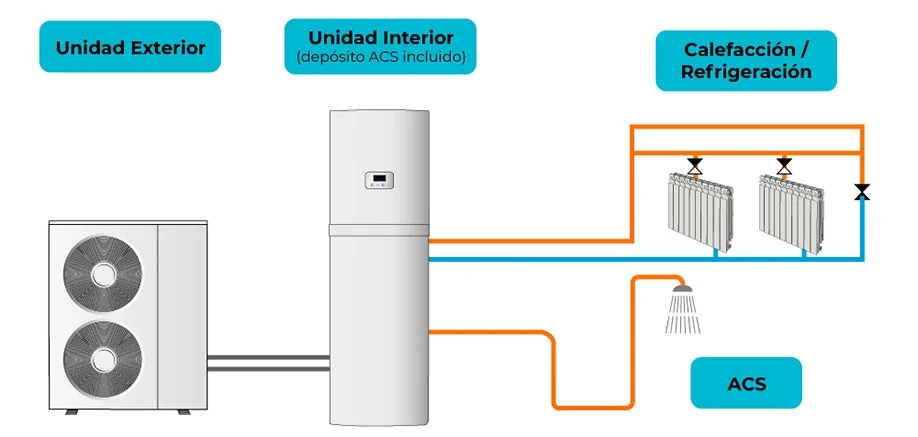
| Air-to-water | Outdoor air | Water circuit | Heating, cooling, DHW |
| Water-to-water | Water | Water circuit | Heating, cooling, DHW |
| Geothermal | Ground | Hydraulic circuit | Heating, cooling, DHW |
Air-to-water is the most common configuration for aérothermal pumps; water from the circuit is delivered to underfloor heating, radiant ceilings, fan coils, radiators designed for low-temperature operation, or DHW tanks. Geothermal systems exchange energy with the ground through borehole heat exchangers or buried circuits with a heat-transfer fluid; ground temperature is more stable than outdoor air, but a specialized collection system and a preliminary site survey are required.
A heat pump can cover several thermal services of a building: heating, cooling, and, in some systems, domestic hot water (DHW). For DHW, there are both integrated functions within climate systems and dedicated units (compact or split), where energy from the environment is used to heat water in a storage tank.
Efficiency Metrics: COP and SCOP
Heat pump efficiency is not expressed as a fixed percentage of savings: it depends on equipment, operating temperatures, climate, building, emitters, controls, operating mode, and the cost of various energy sources.
COP (Coefficient of Performance) — the ratio of useful thermal energy delivered by the pump to the electrical energy consumed under specified test conditions. A COP of 4 means that, under those conditions, the system delivers 4 kWh of thermal energy per 1 kWh of electrical energy. This is not "400% efficiency" in the ordinary sense: the difference is the thermal energy extracted from the environment.
SCOP (Seasonal Coefficient of Performance) — a seasonal metric that accounts for varying loads and temperatures throughout the entire heating season. For comparing pumps intended for heating, seasonal values and the conditions under which they are calculated are more informative than a single COP.
Factors Affecting Real-World Efficiency
- External source temperature: the smaller the thermal differential, the more favourable the operating conditions.
- Flow temperature: the pump operates more efficiently at moderate water temperatures on the emitter side.
- Capacity matching: the unit's output must correspond to the building's actual thermal loads.
- Thermal envelope: lower heat losses reduce the required energy.
- Emitters: underfloor heating, radiant ceilings, fan coils, and individual radiators can be designed for compatibility with heat pumps.
- Controls and management: a correctly tuned climate curve, modulation, and control reduce unnecessary consumption.
- Hydraulic and refrigeration design: balancing, insulation, commissioning, and maintenance affect the final result.
Two installations with the same pump can demonstrate different energy efficiency.
Compatibility with Emitters
Underfloor heating combined with aérothermie is a common solution: large surfaces allow operation at lower water temperatures than in traditional high-temperature systems. Fan coils (water heat exchanger + fan) are compatible with most air-to-water and water-to-water systems. Radiators are also applicable, but it is necessary to verify that their output at the given flow temperature covers the load. In renovation, simply replacing a boiler with a pump is insufficient: thermal loads, existing emitters, and required operating temperatures must be analysed jointly.
Refrigerants and Regulatory Context
The refrigerant is a key element of the cycle: it is the medium that absorbs and releases energy. Refrigerant selection is gaining increasing importance against the backdrop of the evolution of European regulation on fluorinated gases and the gradual phase-down of fluids with high global warming potential.
The market offers fluorinated refrigerants and very low-GWP fluids, including natural propane (R290). The presence of R290 in individual heat pumps is growing, however its flammability requires compliance with safety requirements during design, installation, and maintenance.
Regulation (EU) 2024/573 on fluorinated greenhouse gases establishes phased restrictions affecting both air-conditioning equipment and heat pumps. From 1 January 2026, among other provisions, the use of certain fluorinated gases with GWP ≥ 2500 for servicing and maintenance of such equipment is restricted, subject to exemptions and transition periods provided for in the Regulation itself.
Regulatory Framework in Spain
The design and installation of a heat pump system in Spain is governed by a number of regulatory instruments depending on capacity, installation type, refrigerant, and building characteristics:
- RITE (Reglamento de Instalaciones Térmicas en los Edificios) — requirements for energy efficiency, safety, design, installation, maintenance, and operation of thermal installations.
- CTE (Código Técnico de la Edificación), in particular Basic Document HE (energy savings).
- RSIF (Reglamento de seguridad para instalaciones frigoríficas) — where applicable to the refrigeration circuit.
- Regulation (EU) 2024/573 — phased restrictions on the commercialization and use of certain refrigerants and equipment.
- Safety, electrical installation standards, and other provisions applicable to a specific project.
European regulation on renewable energy sources recognizes, under certain conditions and calculation methodologies, the energy extracted by pumps from air, water, or ground. However, not all delivered thermal energy is counted as renewable: the pump consumes electricity to operate. The regulatory methodology counts only the energy extracted from the environment as renewable and requires a minimum seasonal efficiency from the equipment.
New Construction and Renovation
In new construction, an efficient envelope, low-temperature emitters, technical rooms, and capacities adapted to pump operation are incorporated from the design stage.
In renovation, the preliminary analysis covers:
- actual thermal loads and building needs;
- insulation level of façades, roof, windows, and other envelope elements;
- temperature required by existing emitters;
- available electrical capacity;
- space for outdoor and indoor units;
- DHW provision;
- noise and unit placement;
- possibility to retain, modify, or replace emitters;
- feasibility of hybrid solutions.
Energy renovation may require actions not only on the generator replacement but also on the envelope, emitters, and control system.
AFEC Position
Francisco Perucho, President of AFEC (the association of climate equipment manufacturers), stated in an interview for the #protagonistascaloryfrio series that the deployment of heat pumps in the HVAC market is now certain, above all in new residential construction. In his words, the industry faces a major opportunity and challenge: thousands of residential buildings require renovation, and the market needs decarbonization. At the same time, Perucho emphasized, the final result is determined not only by selecting a unit with good specifications but by the complete design of the installation, building loads, emitters, operating temperatures, controls, and the quality of installation and commissioning. For this reason, it is advisable to conduct a specialized survey of building needs and engage qualified professionals before installing or replacing a climate system.
Brief Answers to Common Questions
- Heating and cooling. Yes, provided the pump is reversible: in winter the cycle delivers heat indoors; in summer it extracts heat and rejects it outdoors.
- DHW. Yes: air-to-water pumps with a DHW function and dedicated units exist.
- Aérothermie and heat pump. The concepts are not identical: a pump is a machine that transfers energy; aérothermie is the thermal energy available in the air. An aérothermal pump uses air as its source.
- Consumption. Pumps in buildings consume electricity for the compressor, fans, pumps, and auxiliary components; useful thermal energy also includes energy extracted from the environment.
- COP or SCOP. In both cases, a higher value indicates a better ratio, but for seasonal heating SCOP is more informative than a single COP.
- Operation at low temperatures. Yes, aérothermal pumps function at low outdoor temperatures, however capacity and efficiency depend on unit characteristics and conditions; selection accounts for climate and loads.
- Radiators. Compatible provided their output at the given flow temperature covers the load; in existing buildings, increasing emitter area, replacing some radiators, reducing the load, or using units rated for higher temperatures may be required.
- Underfloor heating. Particular compatibility due to operation at relatively low water temperatures, but not the only solution: fan coils, radiant ceilings, and individual radiators are also applicable with correct selection.
Outlook
The transition of buildings to more efficient thermal systems, the growing share of electrification, and the gradual reduction of direct fossil fuel combustion are strengthening the role of the heat pump in heating, cooling, and DHW production. Independent information on the technology, its applications, and its role in building decarbonization is available at www.bombadecalor.org.
Source: Caloryfrio. Updated: 5 November 2026, 13:45.
ORIGINAL SOURCE
Caloryfrio ↗Visit the original source for additional details.