Industrial refrigeration
Arctic's Evaporative Cooling Range Targets Industrial Load Gaps with Three Product Lines
Arctic presents its evaporative cooling range — cooling pads, ducted coolers, and indirect-direct evaporative coolers — as a response to the common practice of sizing industrial cooling for average conditions rather than actual operational loads. The three product types differ in humidity impact, air-volume capacity, and installation complexity, and the company frames selection around three practical questions.
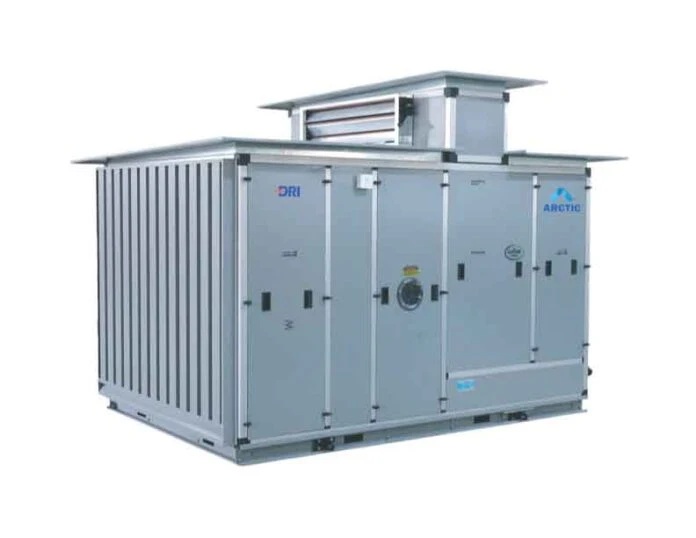
Arctic's evaporative cooling range is built around a specific industrial problem: facilities that size their cooling for an average day rather than the peak loads their operations actually generate. The company offers three product lines — evaporative cooling pads, ducted evaporative coolers, and indirect-direct evaporative coolers (IDEC) — each targeting a different combination of air volume, humidity tolerance, and installation context.
The sizing gap
According to Arctic, a shop floor that runs fine during a normal shift starts falling behind once a second line comes online or an extra shift is added, and the same space is suddenly carrying far more heat than it was built to handle. Two failure modes follow. The first is scale: heat spreads fast across large, open volumes such as shop floors and warehouse aisles, and a system undersized for that volume never quite catches up. The second is density: on assembly lines and in equipment-dense zones, heat and humidity build up together, and controlling one without the other does not solve the problem. Left unaddressed, both issues show up as climbing energy bills, drifting conditions, and output that varies with how hard the line is running rather than holding steady. Arctic notes that these costs are scattered across a year of operation — a slightly higher power bill here, a maintenance call there, a shift's output a few points below target on the day the line runs hardest — which makes them easy to underweight individually.
Water-based cooling instead of refrigerant
Evaporative cooling, as Arctic describes it, uses water rather than refrigerant gas to pull heat out of the air, a lower-energy process by design that often does not require major upgrades to a facility's existing electrical infrastructure.
Three product lines
Arctic's range covers evaporative cooling from three angles:
- Evaporative Cooling Pads — the core media through which water passes to cool incoming air; often a practical way to refresh a system that is already in place.
- Ducted Evaporative Coolers — plug-and-play, single-stage units with duct design available to distribute air across shop floors, warehouses, and other large industrial or commercial spaces; used for comfort cooling and process heat removal alike.
- Indirect-Direct Evaporative Coolers (IDEC) — a multi-stage system that cools with far less added humidity than a ducted cooler and can be configured for larger air volumes, with sensors and controls packaged onboard.
Choosing among the three
Arctic frames the selection around three questions, each carrying a real cost if answered incorrectly:
- Does the air need to stay dry, or is some added humidity acceptable? A ducted cooler is the simpler, single-stage option; an IDEC system adds less humidity but is a more complex, multi-stage system.
- Is this a smaller, single-purpose space, or a larger, more integrated installation? Ducted coolers are simpler to install and duct into open areas; IDEC systems handle larger air volumes with sensors and controls built onboard.
- Is this a new installation or an existing one? Refreshing the media in a system that is already working is a different, and usually less costly, decision than replacing the system outright.
Arctic's position is that none of this requires guessing — it requires asking the three questions before the system goes in, not after operations expose the answer. The facilities that get this right are not necessarily running the newest equipment; they are the ones that sized their cooling for the load their operations actually generate, not the one the original system was built for.
To explore where evaporative cooling can fit into an industrial facility, Arctic directs readers to speak with its Airgineers® at yesARCTIC.com.
Source: Cooling India.
ORIGINAL SOURCE
Cooling India ↗Visit the original source for additional details.