Markets & companies
Canadian cold storage capacity grows 27 per cent as frozen food exports and processing revenue surge
FCC Economics reports that Canadian refrigerated warehouse capacity rose roughly 27 per cent between 2023 and 2026, driven by record vegetable harvests, a 48 per cent jump in frozen food manufacturing revenue, and expanding export volumes. Two new projects in Atlantic Canada and Quebec represent more than C$100 million in additional investment.
Canadian cold storage operators are adding capacity at a pace that mirrors the country's growing frozen and chilled food export trade, according to a new FCC Economics report.
Market forces behind the build-out
In 2025, Canadian vegetable harvest volumes increased 8.0 per cent to approximately 2.6 billion kilograms. Revenue from frozen food manufacturing, which includes frozen fruit and vegetables, grew from C$5.4 billion in 2020 to C$8.0 billion in 2024, a rise of roughly 48 per cent.
Export data between 2020 and 2026 show sustained growth across product categories:
- Frozen fruit and vegetable preparations: +37.2 per cent, equivalent to approximately 415,000 tons
- Fresh or chilled vegetables: +33.4 per cent
- Frozen fruit: +13.3 per cent
- Frozen vegetables: +12.3 per cent
Frozen fruit and vegetable preparations are expected to reach 1.53 million tons in 2026, accounting for 52.8 per cent of frozen-food export volumes. Approximately 99.6 per cent of Canadian frozen vegetable exports went to the United States in 2026. Frozen fruit shipments to Japan, China, and the Netherlands increased compared with 2020, while exports to the U.S. declined. FCC Economics notes that the 2026 figures are annualized using January-to-August data and are not seasonally adjusted.
Capacity expansion and new projects
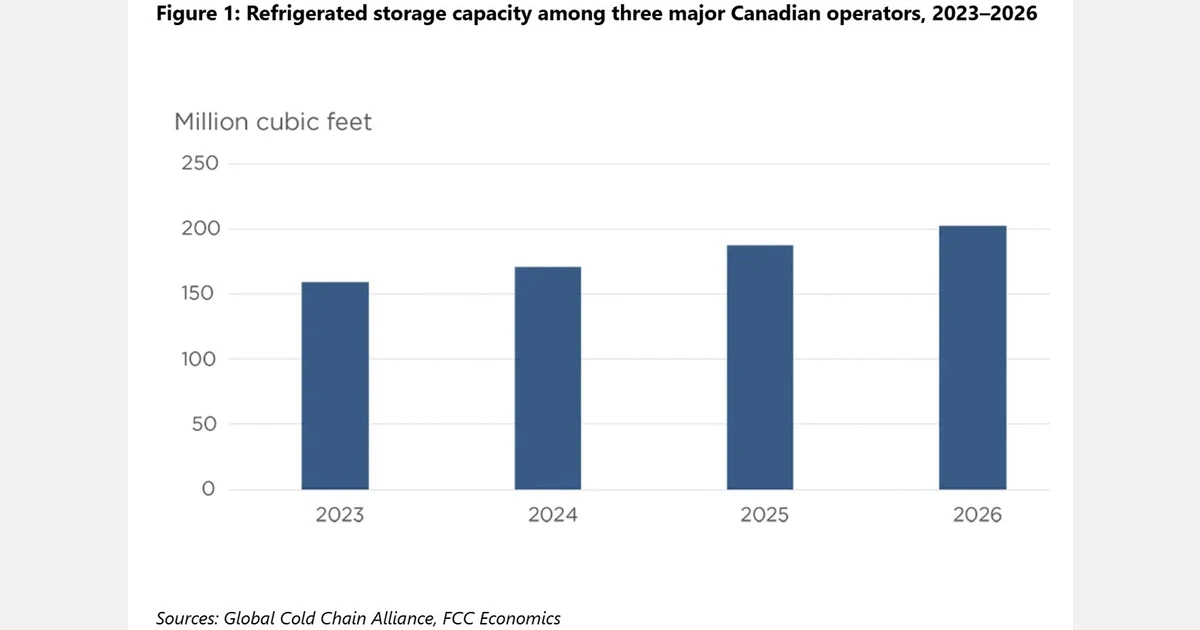
Among three Canadian cold storage operators tracked by FCC Economics, refrigerated warehouse capacity increased approximately 27 per cent, from 159 million cubic feet in 2023 to 203 million cubic feet in 2026.
Further expansion is planned, including two projects in Atlantic Canada and Quebec representing more than C$100 million in investment. One of these is a 190,000-square-foot facility with 22,000 pallet positions and additional refrigerated and frozen storage space.
Larger automation-focused projects are also underway:
- A refrigerated distribution center in Quebec valued at more than C$240 million
- A C$222 million cold storage facility in Alberta incorporating automated storage, retrieval, and material-handling systems
Operational considerations
FCC Economics identifies warehouse utilization, temperature requirements, and transport connectivity as the key factors influencing operator profitability. Operators must align storage capacity with demand across frozen, chilled, and ambient conditions.
Value-added services such as blast freezing, repacking, and handling can generate revenue beyond standard storage fees. Energy costs remain a consideration, with Canadian electricity prices approximately 36 per cent above 2014 levels; investments in refrigeration efficiency, insulation, and energy management can reduce operating expenses.
Warehouse management systems and real-time temperature monitoring are being adopted to improve inventory control, traceability, and temperature management throughout the cold chain.
Source: FCC Economics (Farm Credit Canada). For more information: +1 306 780 8900, www.fcc-fac.ca. Original report via FreshPlaza: Cooling.
ORIGINAL SOURCE
FreshPlaza: Cooling ↗Visit the original source for additional details.